Showing posts with label 01 Aircraft Carrier. Show all posts

Monday, April 26, 2021

HMS Invincible R-05

 Scale 1:700 Dragon (Score 6/10)


https://www.instagram.com/ships_and_models_by_ericknavas/

HMS Invincible was the Royal Navy's lead ship of her class of three light aircraft carriers. She was launched on 3 May 1977 as the seventh ship to carry the name. She was originally designated as an anti-submarine warfare carrier, but was used as an aircraft carrier during the Falklands War, when she was deployed with HMS Hermes. She took over as flagship of the British fleet when Hermes was sold to India. Invincible was also deployed in the Yugoslav Wars and the Second Gulf War (Iraq War). In 2005, she was decommissioned, and was eventually sold for scrap in February 2011.

As built, Invincible was 677 feet (206.3 m) long overall and 632 feet (192.6 m) between perpendiculars, with a beam of 90 feet (27.4 m) at the waterline and 115 feet (35.1 m) at flight deck level, and a draught of 24 feet (7.3 m) at full load. Displacement was 16,000 long tons (16,000 t) standard and 19,500 long tons (19,800 t) full load.[6] The ship was powered by four Rolls-Royce Olympus TBM3 gas turbines, with a maximum total continuous power of 94,000 shaft horsepower (70,000 kW). These drove two propeller shafts via reversible gearboxes, giving a maximum speed of 28 knots (32 mph; 52 km/h). The ship had a range of 5,000 nautical miles (5,800 mi; 9,300 km) at 18 knots (21 mph; 33 km/h).

Invincible's flight deck was 550 feet (167.6 m) long and 55 feet (17 m) wide. It was connected to the ship's hangar by two lifts, with dimensions of 54 feet 8 inches (16.66 m) × 31 feet 8 inches (9.65 m) and rated to carry aircraft with a weight of 35,000 pounds (15,900 kg). The hangar itself was 500 feet (152.4 m) long, with width varying between 74 and 40 feet (22.6 and 12.2 m) and a height of 20 feet (6.1 m). An upward-curved ski-jump ramp at an angle of 6.5 degrees was fitted at the forward end of the ship's flight deck, this allowed the carrier's Sea Harriers to take off with a higher disposal payload, while shortening the take-off run, leaving more space for helicopter operations. The ship had a design air wing of 10 Westland Sea King anti-submarine helicopters and 8 British Aerospace Sea Harrier STOVL jet fighters.

As built, defensive armament consisted of a twin Sea Dart surface to air missile launcher in the ship's bows. 22 Sea Dart missiles were carried. A Type 1022 long-range air-search radar was mounted above the ship's bridge, with Type 909 fire control directors for the Sea Dart system mounted at the fore and aft end of the ship's superstructure. A Type 992 air-surface search radar was mounted on the ship's mainmast, while a Type 1006 navigation radar was also fitted. Type 184 medium range sonar was also fitted.

In September 1982, after returning from the Falklands War, Invincible had her close-in armament supplemented by two Phalanx CIWS and two Oerlikon 20 mm anti-aircraft autocannons. She underwent a major refit in 1986–1989, with several changes to increase the ship's efficiency in operating aircraft. The angle of the ship's ski-jump was increased to 12 degrees, with her hangar modified to allow more aircraft (nine Sea Harriers and twelve Sea Kings) to be accommodated below. The ship's overall length increased to 685.8 feet (209.0 m). Additional command facilities were fitted and accommodation for another 120 people (aircrew and command staff) was added. The ship's magazines were enlarged, allowing Sea Eagle anti-ship missiles for the carrier's Sea Harriers to be carried, while also increasing the number of torpedoes carried for the ship's helicopters. Three Thales 30 mm Goalkeeper CIWS replaced the Phalanxes. Type 996 air-sea search radar replaced the Type 992 radar, with Type 2016 sonar replaced the Type 184. In 2000, Invincible was subject to further modifications to allow her to operate Harrier GR.7s in the ground-attack role. The Sea Dart launcher was removed, while the ship's flight deck was enlarged.

Invincible was ordered from Vickers Shipbuilding and Engineering on 17 April 1973, and was laid down at Vickers' Barrow-in-Furness on 17 April 1973. The ship's construction was delayed by design changes and industrial action, and Invincible was not launched until 3 May 1977. She was accepted into Royal Navy service on 19 March 1980 and after trials, formally commissioned on 11 July 1980. More trials and work-up followed for the ship and her air wing followed before she was declared operational on 19 June 1981, joining the fleet's other carrier Hermes in service.

Invincible's initial air wing consisted of 801 Naval Air Squadron, equipped with five Sea Harriers and 820 Naval Air Squadron, equipped with Sea King anti-submarine helicopters. In August–September 1981, Invicible took part in the NATO naval exercises "Ocean Venture" and "Ocean Safari".

On 25 February 1982, after several months of negotiations, the Australian government announced that it had agreed to buy Invincible for £175 million (285 million A$)[b] as a replacement, under the name HMAS Australia, for the Royal Australian Navy's HMAS Melbourne. Australia planned to make minimal changes to the carrier, adding more fuel and replacing some of the ship's computers. Initially at least, it was planned to operate helicopters only. The sale was confirmed by the Ministry of Defence.

On 2 April 1982, however, Argentina invaded the Falkland Islands. Three days later, a naval task force headed by Invincible and Hermes left HMNB Portsmouth bound for the South Atlantic. On 20 April, the UK government formally ordered its defence forces to bring the islands back under British control. Along with eight Sea Harriers, Invincible's airgroup included twelve Sea King helicopters that were slightly larger than the ship had originally been designed to accommodate. Small machine guns were added around the flight deck and island for close-in defence.

On 23 April, while en route from Ascension Island to the Falklands, Invincible mistakenly locked her Sea Darts on a VARIG Brazilian Airlines DC-10 rather than on the Argentine Air Force Boeing 707 that had been monitoring the fleet's movements. The previous day, Task Group Commander Rear Admiral Sandy Woodward had sought permission from Commander-in-Chief Admiral Sir John Fieldhouse to shoot down the 707 as he believed its activity indicated a raid would be launched from the Argentine aircraft carrier ARA Veinticinco de Mayo. As the 707 would be no direct threat to the fleet, Woodward ordered Weapons Tight and the continued tracking of the aircraft's course while a Sea Harrier was dispatched to investigate. The Harrier pilot reported that "it was a Brazilian airliner, with all the normal navigation and running lights on."

On 30 May, two Super Étendards, one carrying Argentina's last remaining air-launched Exocet, escorted by four A-4C Skyhawks each with two 500 lb (230 kg) bombs, took off to attack Invincible. Argentine intelligence had sought to determine the position of the carriers from analysis of aircraft flight routes from the task force to the islands. However, the British had a standing order that all aircraft conduct a low level transit when leaving or returning to the carriers to disguise their position. This tactic compromised the Argentine attack, which focused on a group of escorts 40 miles south of the main body of ships. Two of the attacking Skyhawks were shot down by Sea Darts fired by HMS Exeter, with HMS Avenger claiming to have shot down the missile with her 4.5" gun (although this claim is disputed). No damage was caused to any British vessels. During the war Argentina claimed to have damaged the ship and continues to do so to this day, although no evidence of any such damage has been produced or uncovered.

On 1 June, the Australian Prime Minister, Malcolm Fraser, advised the British government that the sale of Invincible to Australia could be cancelled if desired. In July 1983, a year after the end of the Falklands conflict, the Ministry of Defence announced that it had withdrawn its offer to sell Invincible so it could maintain a three-carrier force.

In December 1983, Invincible was refused the use of dry dock facilities in Sydney when the Royal Navy declined to divulge to the Australian authorities whether or not the ship was carrying nuclear weapons.

Between 1993 and 1995, Invincible was deployed in the Adriatic for Operation "Deny Flight" and then Operation "Deliberate Force" during the Yugoslav Wars. In 1997, flying the flag of Rear-Admiral Alan West, Commander UK Task Group, Invincible led a deployment that included 3 Commando Brigade Royal Marines. During the following two years, Invincible contributed to Operation "Bolton" (part of Operation "Southern Watch") in southern Iraq before she was redeployed to the Balkans to support the NATO action against Yugoslavia over Kosovo. There, while her helicopters aided refugees, her Harriers were involved in military strikes.

In 2003, Invincible featured in a skit of the BBC show Top Gear involving The Stig racing a white Jaguar XJS on the deck in an attempt to reach 100 mph and stop before the end of the runway. The attempt failed, resulting in The Stig and the Jaguar ending up in the sea.

On 6 June 2005, the British Ministry of Defence announced that Invincible would be inactive until 2010 but available for reactivation at eighteen months' notice. She was decommissioned on 3 August 2005, twenty months after an extensive refit that had been intended to give her ten more years of service. Illustrious succeeded her as the service's flagship. The Royal Navy maintained that Invincible could have been deployed had the need arisen and that Navy policy assumed she was still an active aircraft carrier. According to Jane's, however, Invincible had been stripped of some parts for her sister ships, so operational readiness would require not only eighteen months but also the replacement or removal of systems from those other ships.

In March 2010, Invincible was tied up and minimally maintained with other decommissioned ships up-river of HMNB Portsmouth. On 10 September 2010, she was struck off the Naval Reserve List[36] and, in December, offered for sale by the Disposal Services Authority (DSA) with tenders due by 5 January 2011. The DSA tender documents confirmed that the ship's engines had been removed and that its generators and pumps were "generally unserviceable or not working". On 8 January 2011, the British press relayed an earlier report in the South China Morning Post that a £5-million bid had been made for the ship by the UK-based Chinese businessman Lam Kin-bong with plans to moor her at Zhuhai or Liverpool as a floating international school. In light, however, of China's re-arming of the Varyag – bought under a similar pretext – and the EU arms embargo on China, doubts were raised as to whether such a sale would go ahead.

A month later, in February 2011, BBC News reported that the Ministry of Defence had announced the sale of Invincible to Leyal Ship Recycling in Turkey. She was towed out of Portsmouth on 24 March and arrived at Leyal's Aliağa yard on 12 April 2011 for scrapping.

Invincible initially lacked any close-in weapon systems. As one of the lessons from the Falklands War Invincible had two 20 mm Raytheon Phalanx close-in weapon systems fitted but these were later replaced by three Thales 30 mm Goalkeeper CIWS; there are also two Oerlikon 20 mm cannons. Countermeasures were provided by a Thales jamming system and ECM system, Seagnat launchers provide for chaff or flare decoys. Initially the carriers were armed with a Sea Dart missile system, but this was removed to enlarge the flight deck and to allow magazine storage and deck space for Royal Air Force Harrier GR7s.

After the various refits, the carrier's air group grew from the original planned 5 Sea Harriers and 9 Sea Kings to nine Sea Harrier or Harrier GR7/9s and twelve helicopters (usually all Sea Kings, either anti-submarine warfare (ASW) or Airborne Early Warning (AEW) variants). Alternative airgroups were occasionally tested with 16 Harriers and 3 helicopters being embarked. The carrier was equipped with flagship facilities and could provide an operational headquarters for Royal Navy task forces. The runway was 170 metres (560 ft) long and included the ship's characteristic ski jump (initially at an angle of 7°, but later increased to 12°).

General characteristics

Class and type: Invincible-class aircraft carrier

Displacement:

16,000 t (16,000 long tons) (light)[3]

22,000 t (22,000 long tons) fully loaded

Length: 689 ft (210 m)

Beam: 118.1 ft (36.0 m)

Draught: 28.9 ft (8.8 m)

Propulsion:

4 × Rolls-Royce Olympus TM3B gas turbines providing 97,000 hp (72,000 kW)

8 Paxman Valenta diesel generators

Speed: 28 knots (52 km/h; 32 mph) max

Range: 7,000 nmi (13,000 km; 8,100 mi) at 18 knots (33 km/h; 21 mph)

Complement: 1,051 total, including 726 ship's company and 384 Air Group personnel

Armament:

3 × Goalkeeper CIWS

2 × GAM-B01 20 mm close-range guns

Aircraft carried:

Until December 2010, 22 aircraft;

Multi Mission - Strike, ASuW and ASW

12 x Harrier GR.7/9

10 x Sea King ASaC and Merlin HM Mk.1 helicopters

Multi Mission - Strike and ASuW

18 x Harrier GR.7/9

4 x Sea King ASaC and Merlin HM Mk.1 helicopters


Friday, April 16, 2021

ROKS Dokdo LPH-6111

 Scale 1:700 Brand Academy (Score 6/10)


https://www.instagram.com/ships_and_models_by_ericknavas/

ROKS Dokdo (LPH-6111) is the lead ship of the Dokdo-class amphibious assault ship of the Republic of Korea Navy, launched on 12 July 2005 at the shipyard of Hanjin Heavy Industries & Constructions Co. in Busan. Presently Dokdo is the flagship and the largest vessel in the South Korean navy. Previously, this title was held by the 9,000-ton at-sea Underway Replenishment (UNREP) support vessel ROKS Cheonji.

The name Dokdo comes from the Korean name for the Liancourt Rocks, a group of islets in the Sea of Japan that are currently administered by South Korea. The islets' ownership is disputed between Japan and South Korea. The Japanese Ministry of Foreign Affairs expressed its regret over the naming of Dokdo.

ROKS Dokdo was commissioned into the ROK Navy on 3 July 2007.

In March 2010, Dokdo assisted in search and rescue operations after the sinking of ROKS Cheonan. In July, the ship took part in Operation Invincible Spirit, a joint alliance exercise.

ROKS Dokdo

Namesake: Dokdo

Operator: Republic of Korea Navy, South Korea

Ordered: 28 October 2002

Builder: Hanjin Heavy Industries & Constructions Co., Busan, South Korea

Cost: $650 million

Launched: 12 July 2005

Completed: 2007

Commissioned: 3 July 2007

Status: Active

General characteristics

Class and type: Dokdo-class amphibious assault ship

Displacement:

14,300 tons empty

18,800 tons full load[1]

Length: 199 m (652 ft 11 in)

Beam: 31 m (101 ft 8 in)

Draught: 7 m (23 ft 0 in)

Propulsion: 4 SEMT Pielstick 16 PC2.5 STC diesel engines ~41,600 shp

Speed:

23 knots (43 km/h; 26 mph) max

18 knots (33 km/h; 21 mph) cruising

Boats & landing

craft carried: 2 LSF-II or LCAC

Capacity: Up to 200 vehicles

Troops: 720 marines, 6 tanks, 7 amphibious assault vehicles

Crew: 330[2]

Sensors and

processing systems: SMART-L air search radar, MW08 surface search radar, AN/SPS-95K navigation radar, TACAN, VAMPIR-MB optronic sight

Electronic warfare

& decoys: ESM/ECM:SLQ-200(v)5K SONATA, Chaff launcher

Armament: Two Goalkeeper CIWS, One RIM-116 Rolling Airframe Missile

Aircraft carried: Up to 15 helicopters (15 UH-60 Black Hawk or 10 SH-60F Ocean Hawk helicopters)


Tuesday, April 13, 2021

HMS Ark Royal R07

 Scale 1:700 Dragon (Score 6/10)


https://www.instagram.com/ships_and_models_by_ericknavas/

HMS Ark Royal was a light aircraft carrier and former flagship of the Royal Navy. She was the third and final vessel of Invincible class. She was built by Swan Hunter on the River Tyne and launched by them in 1981. Ark Royal was christened by Queen Elizabeth The Queen Mother. She followed sister ships HMS Invincible and HMS Illustrious into service in 1985.

Affectionately known as The Mighty Ark, she is the fifth Royal Navy ship to have borne the name of the 1587 flagship that defeated the Spanish Armada in 1588. Originally intended to be named Indomitable to match the rest of the class, this was changed due to the public reaction to the loss of the Ark Royal name after the scrapping of the previous Ark Royal in 1980, after 30 years' service.

Slightly larger than her sister ships, and with a steeper ski-jump ramp, Ark Royal carried the STOVL (Short Take Off and Vertical Landing) Harrier Jump Jet aircraft, as well as various helicopters. With a crew complement of over 1,000 sailors and aviators, she saw active service in the 1990s Bosnian War and the 2003 Invasion of Iraq.

Originally due to be retired in 2016, Ark Royal was instead decommissioned on 11 March 2011, as part of the Navy restructuring portion of the 2010 Strategic Defence and Security Review. After Ark Royal's decommissioning HMS Albion replaced her as the Royal Navy flagship. Ark Royal was sold for scrap to the Turkish company Leyal Ship Recycling and left Portsmouth in May 2013.

The aircraft carrier's keel was laid by Swan Hunter at Wallsend on 7 December 1978. She was launched on 2 June 1981 sponsored by the Queen Mother and commissioned on 1 November 1985. Originally intended as Indomitable in line with her sister ships Invincible and Illustrious, public resentment at the scrapping of the previous Ark Royal (the UK's last large aircraft carrier up to that date) in 1980 led the Royal Navy to announce that the name would be revived on the new ship. The unfinished Ark Royal was reportedly offered for sale to the Royal Australian Navy in 1981. HMS Invincible was later offered for sale instead.

Ark Royal was deployed in 1993 to the Adriatic Sea during the Bosnian War under the command of Captain Terry Loughran RN (later rear admiral). In May 1999 she put into Rosyth for refitting, which included the removal of the Sea Dart surface-to-air missiles and covering over of the foredeck to allow for an enlarged deck park for aircraft.

She was recommissioned on 22 November 2001 by Queen Elizabeth The Queen Mother. She sailed to the Persian Gulf for the 2003 Invasion of Iraq. Commanded by Captain Alan Massey (later Vice Admiral and Second Sea Lord) and with a complement consisting of helicopters alone rather than her usual mix of helicopters and Harrier aircraft. During operations in the war two Westland Sea King helicopters, from 849 Naval Air Squadron, collided in mid-air with the loss of six British and one American lives. Her deployment to the gulf was filmed throughout by Shine TV for a Channel 5 documentary entitled 'Ark Royal'.

n April 2004 Ark Royal entered into extended readiness, following which she entered refit with the return to service of Illustrious. Ark Royal completed an extensive refit and received a new captain (Captain Mike Mansergh) in August 2006, then returned to Portsmouth, her home port, to rejoin the fleet on 28 October 2006 where she underwent ten weeks of training and sea trials before being utilised as a landing platform helicopter, replacing Ocean while she underwent a refit. On 16 November 2006 a British Army WAH-64 Apache attack helicopter landed on Ark Royal for the first time marking an increase in the carrier's capability.

On 22 March 2007, Ark Royal was returned to the Royal Navy Fleet after a two-year refit worth £18 million. As of May 2007, she once again became the Fleet Flagship, reclaiming the title from her sister ship, Illustrious, which had been flagship since the end of her refit in 2005. On 31 July 2008, Mansergh was relieved as captain by Captain John Clink. In October 2008, Ark Royal was a participant in Exercise Joint Warrior 08-2. In January 2009 Ark Royal visited Liverpool and then the River Tyne, where she was built. Her voyage from Portsmouth to Liverpool was made with 108 Cadets from the Sea Cadet Corps and the Combined Cadet Force embarked.

During the air travel disruption after the 2010 Eyjafjallajökull eruption, the then Prime Minister, Gordon Brown, assigned Ark Royal and Ocean to rescue stranded travellers across the English Channel in Operation Cunningham. In June 2010 Ark Royal was in Halifax, Nova Scotia, to take part in the Royal Canadian Navy Centennial Celebrations, where she was visited by the British Prime Minister, David Cameron, on his way to the G20 summit in Toronto. During this time a V-22 Osprey visited the ship, again increasing its capabilities.

On 19 October 2010, BBC News reported that the ship was to be decommissioned and scrapped earlier than expected, as part of the coalition government's spending review and expected 8% cut to the British defence budget to be announced later that week, to be replaced in the long run with HMS Prince of Wales.A campaign was begun in November 2010 to retain the name Ark Royal for one of the new carriers. On 3 December 2010, the amphibious warfare ship HMS Albion was announced as Ark Royal's successor as the Royal Navy's flagship. In recognition of the ship's decommissioning, Portsmouth F.C. added the ship's motto to its 2011/12 season kit.

On the evening of 19 October, the ship arrived at Portsmouth ready to be decommissioned and laid up. On 5 November she was visited by Queen Elizabeth at Portsmouth before sailing to Loch Long for the removal of all her munitions. She then left the River Clyde on 17 November on her final voyage before decommissioning, visiting North Shields on 18–22 November and Hamburg for five days from 25 November. The latter was her last overseas visit, repeating a previous one in 2007. During the voyage she launched four Harrier GR9s for the last time in the North Sea on 24 November

The ship then sailed from Hamburg back into Portsmouth, arriving at 9.40 am on 3 December 2010 flying a decommissioning pennant, though bad weather prevented a Harrier flypast to mark the occasion. A farewell parade by her captain and crew was held in Guildhall Square in Portsmouth on 22 January 2011 and another in Leeds, the latter being a Freedom of the City parade. Her formal decommissioning occurred at Portsmouth on 11 March 2011. She was then to have sailed to Rosyth or Govan, but instead de-stored at Portsmouth in late March after her decommissioning, with her last crew members leaving her by 25 May.

A Ministry of Defence spokesperson stated on 1 December 2010 that, "All options are being considered in terms of what happens to the Ark Royal after it is decommissioned. We might also look at scrapping it, selling it or recycling it." Other options explored were to moor her as a hotel, casino, museum ship or visitor attraction at the Royal Docks in east London or at Mablethorpe in Lincolnshire, along the lines of USS Intrepid or HMS Belfast. The annual cost of running the ship as a museum was estimated at £1 million. Another option explored was to moor her as a floating helipad in London's Royal Albert Dock, though that would have been against the London Plan to create no new helipads in London. Another option considered was to turn Ark Royal into a hospital ship with the ability to respond to humanitarian disasters. The possibility of scuttling Ark Royal off the Devonshire coast as an artificial reef was also discussed.

On 28 March 2011 the Ministry of Defence placed the decommissioned Ark Royal up for sale by auction, with 6 July as the final date for tenders. In June 2012, the MoD confirmed it had not reached a decision on the sale of the ship, following the submission of bids nearly a year previously. In September 2012, the announcement was made that the ship had been sold to Leyal Ship Recycling in Turkey for scrapping, for the sum of £2.9m. Ark Royal left Portsmouth on 20 May 2013 to be taken to Leyal Ship Recycling. The ship was towed to scrapyard on 10 June 2013 in Aliağa.

Name: Ark Royal

Namesake: The 1587 flagship that defeated the Spanish Armada in 1588, Ark Royal

Ordered: December 1978

Builder: Swan Hunter, Tyne and Wear, United Kingdom

Laid down: 14 December 1978

Launched: 2 June 1981

Sponsored by: Queen Elizabeth The Queen Mother

Commissioned: 1 November 1985

Decommissioned: 11 March 2011

Refit:

First Major 1999–2001

Second Major 2004–2007

Homeport: HMNB Portsmouth

Identification:

IMO number: 8949575

Pennant number: R07

International Callsign: GCDG

Deck code: R

Motto: Zeal Does Not Rest

Nickname(s): Noah's Ark

Honours and

awards: Al Faw 2003

Fate: Scrapped in Turkey, June 2013

Badge: Ship's Badge

General characteristics

Class and type: Invincible-class aircraft carrier

Displacement: 22,000 tons[5]

Length: 210 m (689.0 ft) (689 ft)

Beam: 36 m (118.1 ft)

Draught: 7.5 m (24.6 ft)

Propulsion:

4 × Rolls-Royce Olympus TM3B gas turbines providing 97,000 hp (72,333 kW)

8 Paxman Valenta diesel generators.

Speed: 28 knots (52 km/h; 32 mph)+

Range: 5,000 nmi (9,300 km; 5,800 mi) at 18 knots (33 km/h; 21 mph)

Complement:

685 crew

366 Fleet Air Arm

Armament:

3 × Mark 15 Phalanx CIWS

2 × GAM-B01 20 mm guns

Aircraft carried:

Until December 2010, 22 aircraft;

Multi Mission - Strike, ASuW and ASW

12 x Harrier GR.7/9

10 x Sea King ASaC and Merlin HM Mk.1 helicopters

Multi Mission - Strike and ASuW

18 x Harrier GR.7/9

4 x Sea King ASaC and Merlin HM Mk.1 helicopters


Monday, April 12, 2021

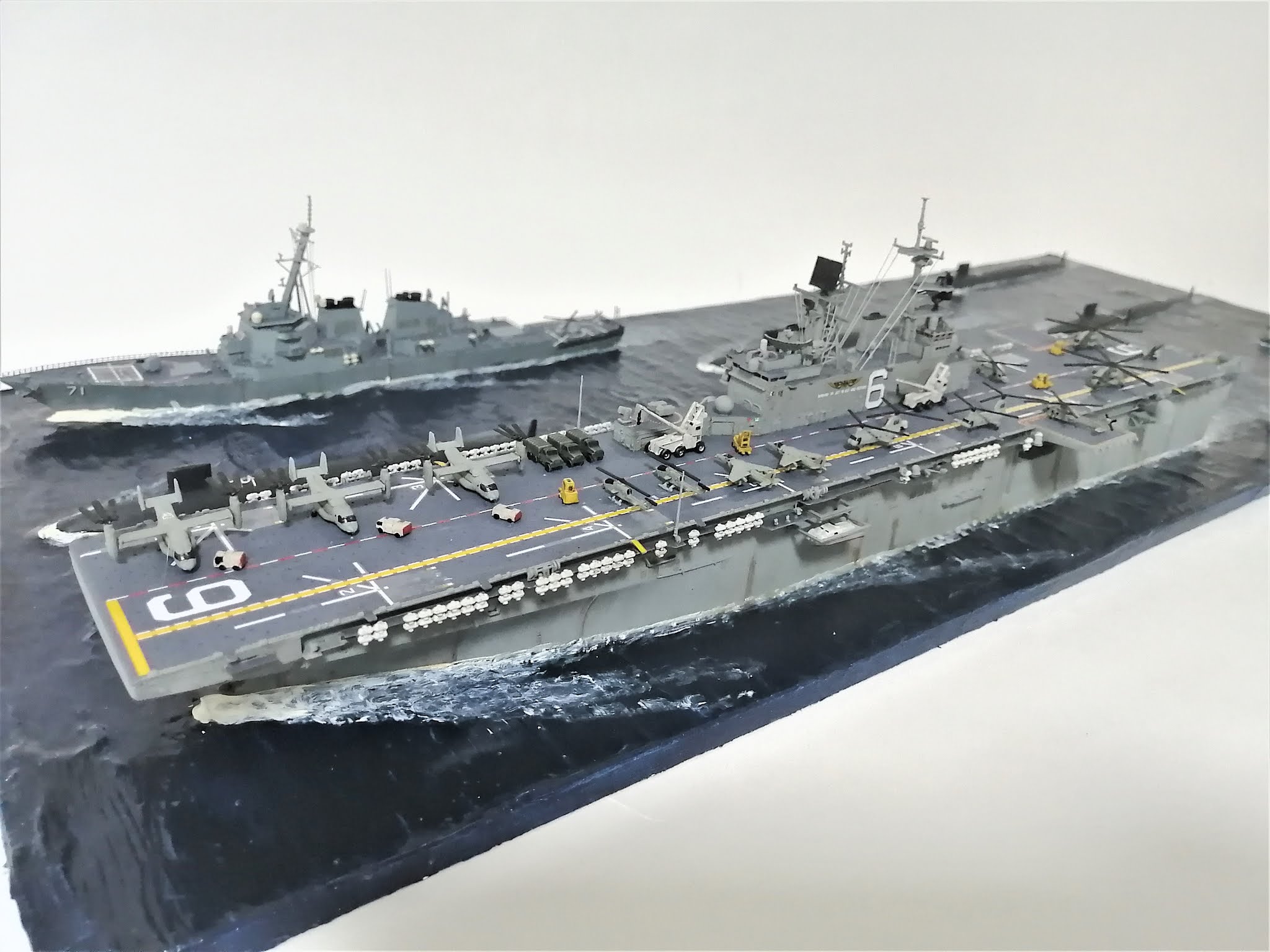
USS Bonhomme Richard LHD-6

  Scale 1:700 Brand Hobbyboss (Kit score 9/10)


www.facebook.com/ericknnavas/

www.instagram.com/ships_and_models_by_ericknavas/

USS Bonhomme Richard (LHD-6) is a Wasp-class amphibious assault ship of the United States Navy commissioned on 15 August 1998. Like the previous five Wasp-class ships, Bonhomme Richard is designed to embark, deploy and land elements of a Marine landing force in amphibious assault operations by helicopter, landing craft and amphibious vehicle, and if needed, to act as a light aircraft carrier.

LHD-6 is the third ship of the United States Navy to bear the name first given by John Paul Jones to his Continental Navy frigate, named in French "Good Man Richard" in honor of Benjamin Franklin, the publisher of Poor Richard's Almanac who at the time served as U.S. ambassador to France.

On 12 July 2020, a fire started on a lower vehicle storage deck while the ship was undergoing maintenance at Naval Base San Diego. It took four days for firefighters to extinguish the fire, which injured at least 63 sailors and civilians and severely damaged the ship; the cause of the fire is still under investigation. Navy leaders decided to decommission and scrap the ship because repairs were estimated to take up to seven years and cost up to $3.2 billion. Some of the ship's salvageable parts will be removed and stored for use in other ships. She is scheduled to be decommissioned on 14 April 2021.

The contract to build her was awarded to Ingalls Shipbuilding on 11 December 1992, and her keel was laid down on 18 April 1995. She was launched on 14 March 1997, delivered to the Navy on 12 May 1998, and commissioned on 15 August 1998.

The average cost of a Wasp-class landing helicopter dock (LHD) ship was estimated to be about $750 million whereas the program unit cost of an America Class LHA (landing helicopter assault) was expected to be about $3.3 billion (2015 dollars). Cost of replacement was estimated about $4 billion (2020 dollars).

Bonhomme Richard departed her building yard, Ingalls Shipbuilding division of Litton Industries, Pascagoula, Mississippi, on 8 August 1998, sailing into Pensacola Harbor at Naval Air Station Pensacola for commissioning activities and culminating with the main ceremony, which was held on 15 August 1998.

U.S. Representative John P. Murtha, of Pennsylvania's 12th Congressional District, delivered the principal commissioning address. Then Secretary of the Navy, John H. Dalton, placed the new ship in commission. Congressman Murtha's wife, Mrs. Joyce Murtha, served as Ship Sponsor, and christened the ship at Ingalls in May 1997. During the commissioning, Mrs. Murtha gave the traditional order to "Man our ship and bring her to life!"

Bonhomme Richard participated in several operations. From 24 January to 24 July 2000, the ship made the first Western Pacific (WESTPAC) deployment of any U.S. Navy ship in the 2000s as part of Operation Southern Watch. She deployed as part of Operation Enduring Freedom from 1 December 2001 to 18 June 2002.

Her next deployment was in support of Operation Iraqi Freedom, beginning 17 January 2003 and lasting to 26 July 2003. Bonhomme Richard played two significant roles in Operation Iraqi Freedom; first, she offloaded more than 1,000 marines and gear from the 3rd Battalion, 1st Marines into Kuwait. Second, after delivering her attack and transport helicopters, troops, and vehicles, she took up position just miles off the coast of Kuwait and became one of two light aircraft carriers, or "Harrier Carriers", along with USS Bataan in the Persian Gulf, launching AV-8B Harrier strike aircraft into Iraq. Pilots from Marine Attack Squadron 211 (VMA-211) and VMA-311, embarked aboard Bonhomme Richard, expended more than 175,000 pounds (79,000 kg) of ordnance, providing close air support to the Marines on the ground and during predetermined strikes in Iraq. During Operation Iraqi Freedom, Bonhomme Richard launched more than 800 sorties, including 547 combat launches.

Beginning 6 December 2004, Bonhomme Richard detached as a supporting unit of Operation Iraqi Freedom and sailed to Sri Lanka to provide support for relief efforts following the 2004 Indian Ocean earthquake and its subsequent tsunamis. On 4 January 2005, the ship helped airlift relief supplies to the coast of Sumatra, Indonesia.

Bonhomme Richard deployed in Operation Unified Assistance from 5 January 2005 to February 2005. On a port visit in Guam on 28 December, the ship and her Expeditionary Strike Group (ESG) were ordered to the Indian Ocean to help in relief efforts following the 2004 Indian Ocean earthquake. Her helicopters flew supplies and medical personnel into various areas of Indonesia, as well as evacuating the wounded.

The following July, Bonhomme Richard participated in RIMPAC 2006. From 23 May to November 2007 she joined up with two U.S. Navy aircraft carriers, John C. Stennis and Nimitz and their Carrier Strike Groups (CSG) off the coast of Iran to carry out previously unannounced air and sea exercises. In July 2008, the ship took part in RIMPAC 2008 off the coast of Hawaii.

From September 2009 to April 2010, Bonhomme Richard deployed to the Fifth and Seventh Fleet Areas of Operations (AoR). Ports of call include East Timor; Phuket, Thailand; Kuala Lumpur, Malaysia; and Oahu, Hawaii. In July she participated in RIMPAC 2010 in the Kaulakahi Channel, between Kauai and Niihau Islands, Hawaii, near the Pacific Missile Range Facility.

Bonhomme Richard took the place of USS Essex as the command ship for Expeditionary Strike Group Seven and switched homeport from San Diego, California to Sasebo, Japan, on 23 April 2012.

During the summer of 2013 Bonhomme Richard participated in Exercise Talisman Sabre 2013. Maneuvers were performed off Queensland, Australia and in the Coral Sea. After the exercise, the ship sailed for Sydney, arriving 16 August 2013.

Bonhomme Richard assisted in the air-sea rescue operation of the capsized South Korean ferry MV Sewol with helicopters on 16 April 2014.

Bonhomme Richard participated in Exercise Talisman Saber 2017 involving more than 33,000 Australian and U.S. troops in June 2017.[citation needed] Alongside Bonhomme Richard, 20 other ships and over 200 aircraft took part in what was Australia's largest exercise to date.[18] This was followed by a week long port call in Melbourne.

On 5 August 2017 a U.S. Marine Corps MV-22 Osprey of Marine Medium Tiltrotor Squadron 265 with the 31st Marine Expeditionary Unit took off from Bonhomme Richard and then crashed in Shoalwater Bay on the east coast of Australia. Twenty-three personnel were rescued, while three died, their bodies being recovered about three weeks later.

On 8 May 2018 Bonhomme Richard completed her homeport change to San Diego.

An explosion occurred about 8:50 a.m. on 12 July 2020 aboard Bonhomme Richard while in her homeport at Naval Base San Diego undergoing maintenance. The resulting fire was fueled by paper, cloth, rags or other materials, not fuel oil or other hazardous materials, Rear Admiral Philip Sobeck, commander of Expeditionary Strike Group 3, told reporters that evening. Since the ship was in maintenance, on-board fire-suppression systems had been disabled, delaying the onset of firefighting efforts, according to Admiral Sobeck. The fire was reported to have started in an area that is normally used to park military trucks while the ship is at sea, but where shipyard workers might have temporarily placed other items including combustible materials.

The day the fire erupted, 17 sailors and four civilians were taken to the hospital with non-life-threatening injuries; all but five were released by morning of the next day, navy officials said. By 14 July the number of injured had risen to 61, as more people were treated for minor injuries, including heat exhaustion and smoke inhalation, the following day.

On 16 July, five days after the explosion, the Navy announced that all fires had been extinguished. The minor injury total had risen to 63 total (40 sailors and 23 civilians). Admiral Michael Gilday, Chief of Naval Operations, said the event was "a very, very serious incident" and that the Navy would address any systemic problems. He said the firefighting efforts had involved sailors from many ships and units in San Diego, including the helicopter squadron HSC-3, which dropped water on the ship.

Fire and water damage were sustained on 11 of 14 decks. Sections of the flight deck and other decks were warped and bulging, while the island was nearly gutted. The Navy removed the aft mast of the damaged ship to ensure it would not collapse.

Nine sailors assigned to Bonhomme Richard were meritoriously promoted in rank on 31 July for their actions in fighting the fire.

On 26 August, news outlets reported that a sailor from the ship was being investigated for arson, but no motive had been identified and no one had been charged. The Naval Criminal Investigative Service, along with other federal agencies continue to investigate.

Three investigations are ongoing related to the fire. Two investigations are being conducted by Naval Sea Systems Command: the first is a failure review board investigation of safety issues relating to ship design and structure, and how changes could prevent future fires from spreading through ships under similar circumstances; the second is a safety review related to the events and activities that occurred on the ship prior to the fire and their relation to existing navy policies and procedures; finally, an investigation into command issues is being led by Vice Admiral Scott Conn, the commander of the 3rd Fleet.

On 30 November 2020, Navy officials said that attempting to repair the damage and return Bonhomme Richard to service would take between five and seven years and cost an estimated $2.5 billion to $3.2 billion. Instead, the decision was made to withdraw the ship from service and, following extensive component recovery, have her sold for scrap. In February 2021, a bipartisan group of congressional delegates from Florida proposed that the hulk be sunk off the coast of Florida as an artificial reef, arguing that the reef would become an environmental and economic benefit to the area.

General characteristics

Class and type: Wasp-class amphibious assault ship

Displacement: 40,358 long tons (41,006 t) full load

Length: 844 ft (257 m)

Beam: 105 ft (32 m)

Draft: 27 ft (8.2 m)

Installed power:

2 600 psi (4,100 kPa) boilers

70,000 shp (52,000 kW)

Propulsion:

2 geared steam turbines

two shafts

Speed: 22 kn (41 km/h; 25 mph)

Range: 9,500 nmi (17,600 km; 10,900 mi) at 18 kn (33 km/h; 21 mph)

Well deck dimensions: 266-by-50-foot (81 by 15.2 m) by 28-foot (8.5 m) high

Boats & landing

craft carried:

3 Landing Craft Air Cushion or

2 Landing Craft Utility[2] or

12 Landing Craft Mechanized

Troops: 1,894 troops (plus 184 surge) Marine Detachment

Complement: 1,108

Sensors and

processing systems:

1 AN/SPS-49 2-D Air Search Radar

1 AN/SPS-48 3-D Air Search Radar

1 AN/SPS-67 Surface Search Radar

1 Mk23 Target Acquisition System (TAS)

1 AN/SPN-43 Marshalling Air Traffic Control Radar

1 AN/SPN-35 Air Traffic Control Radar

1 AN/URN-25 TACAN system

1 AN/UPX-24 Identification Friend Foe

Armament:

Two RIM-116 Rolling Airframe Missile launchers

Two RIM-7 Sea Sparrow missile launchers

Two 20 mm Phalanx CIWS systems

Three 25 mm Mk 38 chain guns

Four .50 BMG machine guns

Aircraft carried:

Actual mix depends on the mission

Standard Complement:

6 AV-8B Harrier II attack aircraft

or

6 F-35B Lightning II stealth strike-fighters

4 AH-1W /Z Super Cobra /Viper attack helicopters

12 MV-22B Osprey assault support tiltrotors

4 CH-53E Super Stallion heavy-lift helicopters

3–4 UH-1Y Venom utility helicopters

Assault:

22+ MV-22B Osprey assault support tiltrotors

Sea Control:

20 AV-8B Harrier II attack aircraft

or

20 F-35B Lightning II stealth strike-fighters

6 SH-60F/HH-60H ASW helicopters


Wednesday, March 31, 2021

USS Wasp LHD-1

 Scale 1:700 Brand Hobbyboss (Score 9/10)


https://www.instagram.com/ships_and_models_by_ericknavas/

USS Wasp (LHD-1) is a United States Navy multipurpose amphibious assault ship, and the lead ship of her class. She is the tenth USN vessel to bear the name since 1775, with the last two ships named Wasp being aircraft carriers. She was built by the Ingalls Shipbuilding division of Litton in Pascagoula, Mississippi. Wasp and her sister ships are the first specifically designed to accommodate new Landing Craft Air Cushion (LCAC) for fast troop movement over the beach, and Harrier II (AV-8B) Vertical/Short Take-Off and Landing (V/STOL) jets which provide close air support for the assault force. She can also accommodate the full range of Navy and Marine Corps helicopters, the tiltrotor MV-22 Osprey, the F-35B Lightning II multi-role fighter, conventional landing craft, and amphibious vehicles.

To carry out her primary mission, Wasp has an assault support system that synchronizes the simultaneous horizontal and vertical flow of troops, cargo and vehicles throughout the ship. Two aircraft elevators service the hangar bay and flight deck. Six cargo elevators, each 4 by 8 meters (13 by 26 ft), are used to transport material and supplies from the 3,000-cubic-meter (110,000 cu ft) cargo holds throughout the ship to staging areas on the flight deck, hangar bay and vehicle storage area. Cargo is transferred to waiting landing craft docked within the ship's 12,000-square-foot (1,100 m2), 81-meter long (266 ft) well deck. Helicopters in the hangar bay or on the flight deck are cargo-loaded by forklift.

Wasp has medical and dental facilities capable of providing intensive medical assistance to 600 casualties, whether combat incurred or brought aboard ship during humanitarian missions. The ship's corpsmen also provide routine medical/dental care to the crew and embarked personnel. Major medical facilities include four main and two emergency operating rooms, four dental operating rooms, x-ray rooms, a blood bank, laboratories, and patient wards. In addition, three battle dressing stations are located throughout the ship, as well as a casualty collecting area at the flight deck level. Medical elevators rapidly transfer casualties from the flight deck and hangar bay to the medical facilities.

For the comfort of the 1,075 crewmembers and 2,200 embarked troops, all manned spaces and berthing areas are individually heated and air conditioned. Berthing areas are subdivided to provide semi-private spaces without adversely affecting efficiency. Onboard recreational facilities include a Library Multi-Media Resource Center with Internet access, a weight room, and satellite television capabilities.

Wasp's two steam propulsion plants generate a total of 400 tons of steam per hour. The propulsion system develops 70,000 shaft horsepower (52 MW), powering the ship to speeds in excess of 22 knots (41 km/h; 25 mph). USS Wasp was built using more than 21,000 tons of steel, 400 tons of aluminum, 400 miles (640 km) of electrical/electronic cables, 80 miles (130 km) of piping and tubing of various types and sizes, and 10 miles (16 km) of ventilation ducting. Wasp weighed more than 27,000 tons when moved onto the Ingalls floating dry-dock on 30 July 1987 for launch on 4 August 1987, becoming the largest man-made object rolled across land. In 1996, the ship was fitted with the Advanced Combat Direction System (ACDS).

On 20 June 1991, Wasp departed homeport for her maiden six-month Mediterranean deployment. In February 1993, she left her port on an emergency deployment to Somalia to participate in the United Nations intervention: Operation Restore Hope. Chairman of the Joint Chiefs of Staff, General Colin Powell landed on the ship that April for a discussion of military tactics taking place in and around Mogadishu. Following that, she assisted with another operation off the coast of Kuwait. She later made stops in Toulon, France and Rota, Spain, en route to her home port in Norfolk, Virginia. In 1998, she won the Marjorie Sterrett Battleship Fund Award for the Atlantic Fleet.

With the exception of deployments noted below, from 2004 to 2012, Wasp was not deployed as often or as long as other LHDs, as she was assigned to Joint Strike Fighter F-35B Lightning II testing and kept close to the U.S. as much as possible.

n February 2004, Wasp set sail to take the Marines of 1/6 Marine Regiment and HMM-266 Rein to Afghanistan. They arrived at the end of March to offload the Marines, then returned to the U.S. to pick up more Marines from HMH-461 and transported them to Djibouti. After offloading HMH-461 in Djibouti, they picked up the Marines of HMM-266 Rein from Kuwait in August 2004, and returned to Norfolk, Virginia mid-September 2004. On 7 July 2006, Vice President Dick Cheney visited Wasp. He gave a speech honoring the efforts of the USS Nassau Expeditionary Strike Group in Operation Iraqi Freedom.

Wasp was the first ship to deploy the V-22 Osprey, doing so in October 2007, by carrying VMM-263's ten MV-22B Ospreys to Iraq to participate in Operation Iraqi Freedom. Wasp also served as the platform for the program's first Sea Trials in December 1990, involving the third and fourth Osprey prototypes.[5] Wasp was the principal attraction at Fleet Week 2007 in New York City.

On 4 October 2009, Wasp deployed from her base at Norfolk Naval Station in Norfolk, Virginia on a three-month voyage down the Atlantic coast to the Caribbean, with Destroyer Squadron 40 and an embarked Marine Air-Ground Task Force.[6] The 1,100 sailors and 365 embarked Marines conducted operations and exercises in the U.S. 4th Fleet area of responsibility. The operation, called Southern Partnership Station, is part of a maritime strategy, which focuses on building interoperability and cooperation in the region while meeting common challenges.[citation needed] In mid-October 2009, Wasp set anchor at the Guantanamo Bay Naval Base in Cuba and disembarked Marines who were assigned to training status for approximately three months while Wasp went underway.

In September 2007, Wasp sailed to Nicaragua to offer assistance to the victims of Hurricane Felix. On 29 June 2010, Wasp was one of the 18 international vessels taking part in the 100th anniversary celebrations of the Canadian Navy in Halifax, Nova Scotia. The Canadian and international warships were reviewed by Queen Elizabeth II, the Duke of Edinburgh, and Prime Minister Stephen Harper.[7] In 2011, Wasp was modified for F-35B testing, including replacing a Sea Sparrow launcher with monitoring equipment.[8] She returned to sea on 7 July 2011.[9] On 3 October 2011, the F-35B made its first vertical landing at sea on Wasp. On 5 October 2011, Wasp successfully launched her first F-35B.[10]

On 30 January 2012, Wasp set sail for Operation Bold Alligator, the largest amphibious exercise conducted by U.S. forces in the last decade. The exercise took place from 30 January to 12 February, both afloat and ashore in and around Virginia and North Carolina. In May 2012, Wasp participated in New York's Fleet Week, docking at Pier 92 on the Hudson River and offering tours of the ship to the general public.[11] In July 2012, Wasp visited Boston for Fleet Week 2012 and Fourth of July festivities. On 30 October 2012, Wasp was sent towards the Hurricane Sandy impact area in case the USN was needed to support the disaster relief efforts.[12] In June 2016, Wasp deployed for a six-month tour to the Middle East [13] In October 2016, the US Navy announced that Wasp will deploy to Sasebo, Japan in late 2017, replacing her sister ship Bonhomme Richard, which will be moved to San Diego, California.[14] On 1 August 2016, Marine AV-8B Harriers from Wasp began strikes against the Islamic State of Iraq and the Levant in Libya as part of manned and unmanned airstrikes on targets near Sirte, launching at least five times within two days.[15]

The USN planned to deploy Wasp to the Asia-Pacific region in 2017 with a squadron of 16 F-35Bs.[16] In September 2017, Wasp became the first U.S. warship to arrive in the Caribbean to provide supplies, damage assessment, and evacuation assistance in the wake of Hurricane Irma.[17] On 3 March 2018, Wasp departed Sasebo, Japan for a routine patrol of the Indo-Pacific region. A detachment of 6 F-35Bs from VMFA-121 were deployed with the ship, marking the first operational shipboard deployment for the F-35B.[18]

On 27 May 2019, President Donald J. Trump landed in a helicopter aboard the Wasp anchored near Yokosuka, Japan to deliver Memorial Day remarks to the troops during his visit to Japan for a state dinner with Emperor of Japan, Emperor Naruhito and Japanese Prime Minister, Shinzo Abe.

Dark blue and gold are the traditional colors of the US Navy. Blue alludes to the sea, the theater of Naval Operations. Gold is for excellence. The chevron, a traditional symbol for support, represents the amphibious assault mission of the ship. It resembles a wave move to shore and refers to the deployment of men, women and cargo. The wings highlight USS Wasp's aviation heritage and capabilities. The modern ship with crossed officers sword and enlisted cutlass adapted from the surface warfare emblems represents leadership, teamwork and the ship's mission in surface operations. The pile of a sharp pointed "V" shape is expressive of assault, combat readiness and victory. The wasp, with its well-developed wings and ability to administer painful stings, epitomizes quick striking power. The stars recall two of the previous ships named Wasp, CV-7 and CV-18, aircraft carriers that earned two and eight battle stars respectively for World War II service. The red disc or sun refers to World War II Japan and the Pacific Theater where these aircraft carriers saw heavy combat action. The tridents are symbolic of sea power and weaponry.

History

United States

Name: USS Wasp

Namesake: In naming LHD-1 "Wasp", the Navy honors nine previous ships, dating to the American Revolution, which have borne this illustrious name.

Awarded: 28 February 1984

Builder: Ingalls Shipbuilding

Laid down: 30 May 1985

Launched: 4 August 1987

Commissioned: 29 July 1989

Homeport: Naval Station Norfolk

Identification:

MMSI number: 366000001

Callsign: NEBP

Motto: Honor, Tradition, Excellence

Status: in active service

Badge: USS Wasp (LHD-1) crest.png

General characteristics

Type: Landing Helicopter Dock (LHD) amphibious assault ship

Displacement: 40,500 long tons (41,150 t) full load

Length: 843 ft (257 m)

Beam: 104 ft (31.8 m)

Draft: 27 ft (8.1 m)

Propulsion: Two boilers, two geared steam turbines, two shafts, 70,000 shp (52,000 kW);

Speed: 22 knots (41 km/h; 25 mph)

Range: 9,500 nautical miles (17,600 km; 10,900 mi) at 18 kn (33 km/h; 21 mph)

Well deck dimensions: 266-by-50-foot (81 by 15.2 m) by 28-foot (8.5 m) high

Boats & landing

craft carried:

3 Landing Craft Air Cushion or

2 Landing Craft Utility[1] or

12 Landing Craft Mechanized

Troops: 1,687 troops (plus 184 surge) Marine Detachment

Complement: 66 officers, 1,004 enlisted[1]

Sensors and

processing systems:

1 AN/SPS-49 2-D Air Search Radar

1 AN/SPS-48 3-D Air Search Radar

1 AN/SPS-67 Surface Search Radar

1 Mk23 Target Acquisition System (TAS)

1 AN/SPN-43 Marshalling Air Traffic Control Radar

1 AN/SPN-35 Air Traffic Control Radar

1 AN/URN-25 TACAN system

1 AN/UPX-24 Identification Friend Foe

Armament:

Two RIM-116 Rolling Airframe Missile launchers

Two RIM-7 Sea Sparrow missile launchers

Three 20 mm Phalanx CIWS systems

Four 25 mm Mk 38 chain guns

Four .50 BMG machine guns

Aircraft carried:

Actual mix depends on the mission

Standard Complement:

6 AV-8B Harrier II attack aircraft

or

6 F-35B Lightning II stealth strike-fighters

4 AH-1W/Z Super Cobra/Viper attack helicopter

12 MV-22B Osprey assault support tiltrotor

4 CH-53E Super Stallion heavy-lift helicopters

3–4 UH-1Y Venom utility helicopters

Assault:

22+ MV-22B Osprey assault support tiltrotor

Sea Control:

20 AV-8B Harrier II attack aircraft

or

20 F-35B Lightning II stealth strike-fighters

6 SH-60F/HH-60H ASW helicopters


Monday, March 22, 2021

USS Iwo Jima LHD7

 Scale 1:700 Brand Hobbyboss (Kit Score 9/10)


https://www.facebook.com/ericknnavas

https://www.instagram.com/ships_and_models_by_ericknavas/

USS Iwo Jima (LHD-7) is a Wasp-class amphibious assault ship of the United States Navy. The ship was named for the Battle of Iwo Jima of World War II. The ship was commissioned in 2001 and is in service.

Construction and career

Fabrication work for Iwo Jima began at Ingalls shipyard on 3 September 1996, and the ship's keel was laid on 12 December 1997. At the keel laying ceremony, United States Army Captain Jacklyn H. Lucas, who was awarded the Medal of Honor for his actions during the Battle of Iwo Jima, placed his Medal of Honor citation in the hull of the ship, where it remains today.[2] She was launched on 4 February 2000. USS Iwo Jima was christened by her sponsor, Mrs. Zandra Krulak, wife of General Charles C. Krulak, the former Commandant of the Marine Corps, in Pascagoula, Mississippi on 25 March 2000. The commissioning crew moved aboard in April 2001, and made the ship's maiden voyage on 23 June 2001, accompanied by more than 2,000 World War II veterans — many of them survivors of the Battle of Iwo Jima. She was commissioned a week later in Pensacola, Florida, on 30 June 2001.


Shortly thereafter, the ship and crew began an accelerated Inter Deployment Training Cycle, which tested virtually every system on board in realistic combat conditions. Iwo Jima was also the first ship on the waterfront open to the public after the terrorist attacks of 11 September 2001. In 2002, Iwo Jima participated in Fleet Week in New York City.


Ship's history

2003


Iwo Jima and the Marines of the 26th Marine Expeditionary Unit (26 MEU) along with two other amphibious assault ships formed the Iwo Jima Amphibious Ready Group. Iwo Jima left port on 4 March 2003 in support of Operation Enduring Freedom and deployed Marines in April 2003 from the Mediterranean Sea into Northern Iraq for the Iraq War. In July 2003, Iwo Jima deployed to the coast of Liberia as part of JTF Liberia in response to the Second Liberian Civil War. During this operation, the Southern European Task Force (SETAF) as the command element of JTF Liberia and Iwo Jima with the 26 MEU landed Marines in Liberia to perform humanitarian assessments. "At its height, JTF Liberia consisted of over 5,000 service members from the SETAF headquarters, the 26th Marine Expeditionary Unit, the three-ship Iwo Jima Amphibious Ready Group, 3rd Air Force's 398th Air Expeditionary Group, U.S. Army Europe's 21st Theater Support Command, and Army Special Forces."[3]


2004-2005

In 2004, Iwo Jima participated in Fleet Week. Iwo Jima served as the 2nd Fleet flagship in 2005, based out of Norfolk, Virginia.


Hurricane Katrina


On 31 August 2005, Iwo Jima was sortied to the Gulf of Mexico to provide disaster relief and to conduct support operations in the wake of Hurricane Katrina. Iwo Jima sailed up the Mississippi River to the city of New Orleans to directly support relief operations and act as the central command center for all federal, state and local disaster recovery operations.


During this critical period, Iwo Jima also served as the region's only fully functional air field for helicopter operations, conducting over one thousand flight deck operations; provided hot meals, showers, drinking water, and berthing to thousands of National Guardsmen and relief workers; provided medical services, including first aid and surgical services, for disaster victims; and conducted clean-up operations in the city and suburbs of New Orleans.


Iwo Jima served as flagship for the Commander-in-Chief, George W. Bush, during Hurricane Katrina Joint Task Force,[4] and is only the second Navy ship to have been presented the flag of the President of the United States.


2006

On 6 June 2006, Iwo Jima left her homeport of Norfolk, Virginia, and began a regularly scheduled six-month deployment to the U.S. European Command and U.S. Central Command area of responsibilities, as flagship for the Iwo Jima Expeditionary Strike Group, encompassing 6,000 sailors and Marines. The ship was also a part of the evacuation effort of American citizens from the conflict in Lebanon.[5]


News reports on 15 July 2006 stated that Iwo Jima, flagship of the 24th Marine Expeditionary Unit, would be used to evacuate U. S. citizens from Lebanon after the Israeli Defense Force made the Beirut International Airport unusable through bombing its runways and fuel storage areas.[citation needed]


2007

On 16 February 2007, Iwo Jima was awarded the 2006 Battle "E" award.[6]


2009-2012

In 2009, 2010, and 2011, Iwo Jima participated at the annual Fleet Week in New York City.


On 3 November 2010, Iwo Jima was deployed to Haiti in anticipation of providing humanitarian assistance due to an impending Tropical Storm Tomas.[

On 27 March 2012, Iwo Jima was deployed as part of the Iwo Jima Amphibious Ready Group with Marines from the 24th Marine Expeditionary Unit supporting maritime security operations and security cooperation efforts in the U.S. 5th and 6th Fleet areas of responsibility.


On 11 April 2012, an MV-22 from VMM-261 crashed near Agadir, Morocco, during a joint training exercise after taking off from USS Iwo Jima. Two US Marine crew chiefs were killed and the two pilots were seriously injured.


Early in May 2012, Iwo Jima was operating in the Gulf of Aqaba and in the south of the Red Sea. In November 2012, Iwo Jima was dispatched to the eastern Mediterranean, during escalating warfare between Israel and Hamas, in case the evacuation of U.S. citizens from Israel was required, delaying the scheduled return of Iwo Jima to Norfolk.


2014

In August 2014, Iwo Jima shifted homeport to Mayport.


2015

In January 2015, Iwo Jima, USS Fort McHenry and USS New York were positioned off the coast of Yemen on standby to evacuate the staff of the US embassy should the need arise due to the collapse of the Yemeni government.[14]


2016

In October 2016, Iwo Jima sailed to Haiti to relieve USS Mesa Verde, assisting victims of Hurricane Matthew.[15]


2018


In October and November 2018, Iwo Jima participated in NATO's Exercise Trident Juncture 2018 in Norway.


Motto


The ship's motto, "Uncommon Valor", is based on Fleet Admiral Chester W. Nimitz's words when he spoke of Sailors and Marines who fought at Iwo Jima: "Among the Americans who served on Iwo Jima, uncommon valor was a common virtue.

History

United States

Name: USS Iwo Jima

Namesake: Battle of Iwo Jima

Ordered: 28 February 1995

Builder: Ingalls Shipbuilding

Laid down: 12 December 1997

Launched: 4 February 2000

Sponsored by: Zandra Krulak, wife of Commandant of the Marine Corps, Charles C. Krulak

Christened: 25 March 2000

Commissioned: 30 June 2001

Homeport: Naval Station Mayport

Identification:

MMSI number: 338813000

Callsign: NXXG

Motto: Uncommon Valor

Status: in active service

Badge: USS Iwo Jima COA.png

General characteristics

Type: Landing Helicopter Dock (LHD) amphibious assault ship

Displacement: 40,500 long tons (41,150 t) full load

Length: 843 ft (257 m)

Beam: 104 ft (31.8 m)

Draft: 27 ft (8.1 m)

Propulsion: Two boilers, two geared steam turbines, two shafts, 70,000 shp (52,000 kW);

Speed: 22 knots (41 km/h; 25 mph)

Range: 9,500 nautical miles (17,600 km; 10,900 mi) at 18 kn (33 km/h; 21 mph)

Well deck dimensions: 266-by-50-foot (81 by 15.2 m) by 28-foot (8.5 m) high

Boats & landing

craft carried:

3 Landing Craft Air Cushion or

2 Landing Craft Utility[1] or

12 Landing Craft Mechanized

Troops: 1,687 troops (plus 184 surge) Marine Detachment

Complement: 1,208

Sensors and

processing systems:

1 AN/SPS-49 2-D Air Search Radar

1 AN/SPS-48 3-D Air Search Radar

1 AN/SPS-67 Surface Search Radar

1 Mk23 Target Acquisition System (TAS)

1 AN/SPN-43 Marshalling Air Traffic Control Radar

1 AN/SPN-35 Air Traffic Control Radar

1 AN/URN-25 TACAN system

1 AN/UPX-24 Identification Friend Foe

Armament:

Two RIM-116 Rolling Airframe Missile launchers

Two RIM-7 Sea Sparrow missile launchers

Two 20 mm Phalanx CIWS systems

Three 25 mm Mk 38 chain guns

Four .50 BMG machine guns

Aircraft carried:

Actual mix depends on the mission

Standard Complement:

6 AV-8B Harrier II attack aircraft

or

6 F-35B Lightning II stealth strike-fighters

4 AH-1W/Z Super Cobra/Viper attack helicopter

12 MV-22B Osprey assault support tiltrotor

4 CH-53E Super Stallion heavy-lift helicopters

3–4 UH-1Y Venom utility helicopters

Assault:

22+ MV-22B Osprey assault support tiltrotor

Sea Control:

20 AV-8B Harrier II attack aircraft

or

20 F-35B Lightning II stealth strike-fighters

6 SH-60F/HH-60H ASW helicopters