HMS York was a Batch III Type 42 destroyer of the Royal Navy. Launched on 20 June 1982 at Wallsend, Tyne and Wear and sponsored by Lady Gosling, York was the last Type 42 ordered. The ship's crest was the White Rose of York, and the "red cross with lions passant" funnel badge was derived from the coat of arms of the City of York. With a maximum speed of 34 knots (63 km/h; 39 mph), she was the Royal Navy's fastest destroyer.
In the summer of 1990, HMS York was serving on a routine patrol in the Persian Gulf as part of The Armilla Patrol which had been undertaken by a series of Royal Navy warships over many years. On 2 August that year, Saddam Hussein's forces invaded Kuwait. Instead of heading off to the Far East and Australia for series of "waving the flag" port visits, she remained on patrol in the Persian Gulf for an extra three months. This period was conducted when at sea mostly on a war-ready footing, involving virtually everyone onboard working Defence Watches (basically six hours on, six off) round the clock.
Following refit at Rosyth, York rededicated on 30 June 1995 and then worked up to full readiness undertaking operational sea training and a JMC. She then deployed to the Far East and Middle East with visits to Malaysia, Bangladesh, Oman, UAE, Kuwait, Saudi Arabia and Qatar.
In 2001, she tested a RIM-116 Rolling Airframe Missile
In 2003, York took part in the invasion of Iraq providing air cover and area protection for the aircraft carrier HMS Ark Royal. In 2004, she was fitted with the MOD 1 variant of the mark 8 4.5-inch gun. She and Edinburgh were the only two Type 42s to be so fitted.
In July 2006, York joined Gloucester in evacuating British citizens from Beirut in the 2006 Israel-Lebanon conflict making several trips in and out of Lebanon, ferrying evacuees to Cyprus.
In February 2010, York and the auxiliary Wave Ruler were deployed to the Falkland Islands coinciding with a period of increased tensions between the United Kingdom and Argentina over the former's plans to begin drilling for oil in the seas surrounding the islands.
In February 2011, York was deployed to Malta to assist in the evacuation of British nationals from Libya. On 21 April 2011, York arrived at the East Cove Military Port in the Falkland Islands, beginning patrol duties for the islands. On 12 December 2011, York spotted the Russian aircraft carrier Admiral Kuznetsov with its carrier group northeast of Orkney, off the coast of northern Scotland, and shadowed the carrier for a week. This was the first time Admiral Kuznetsov had deployed near UK waters and the closest in 20 years that a Russian naval task group had deployed to the UK. She then sailed around the top of Scotland and into the Atlantic past western Ireland, where she conducted flying operations with her Sukhoi Su-33 Flanker jets and Kamov Ka-27 helicopters in international airspace.
On 13 April 2012, Edinburgh fired the last ever operational Sea Dart missiles after a thirty-year career. As such York completed her career without the system being operational.
York entered Portsmouth harbour for the final time on 20 September 2012, and was decommissioned on 27 September 2012. In August 2012, the ship was put up for sale.
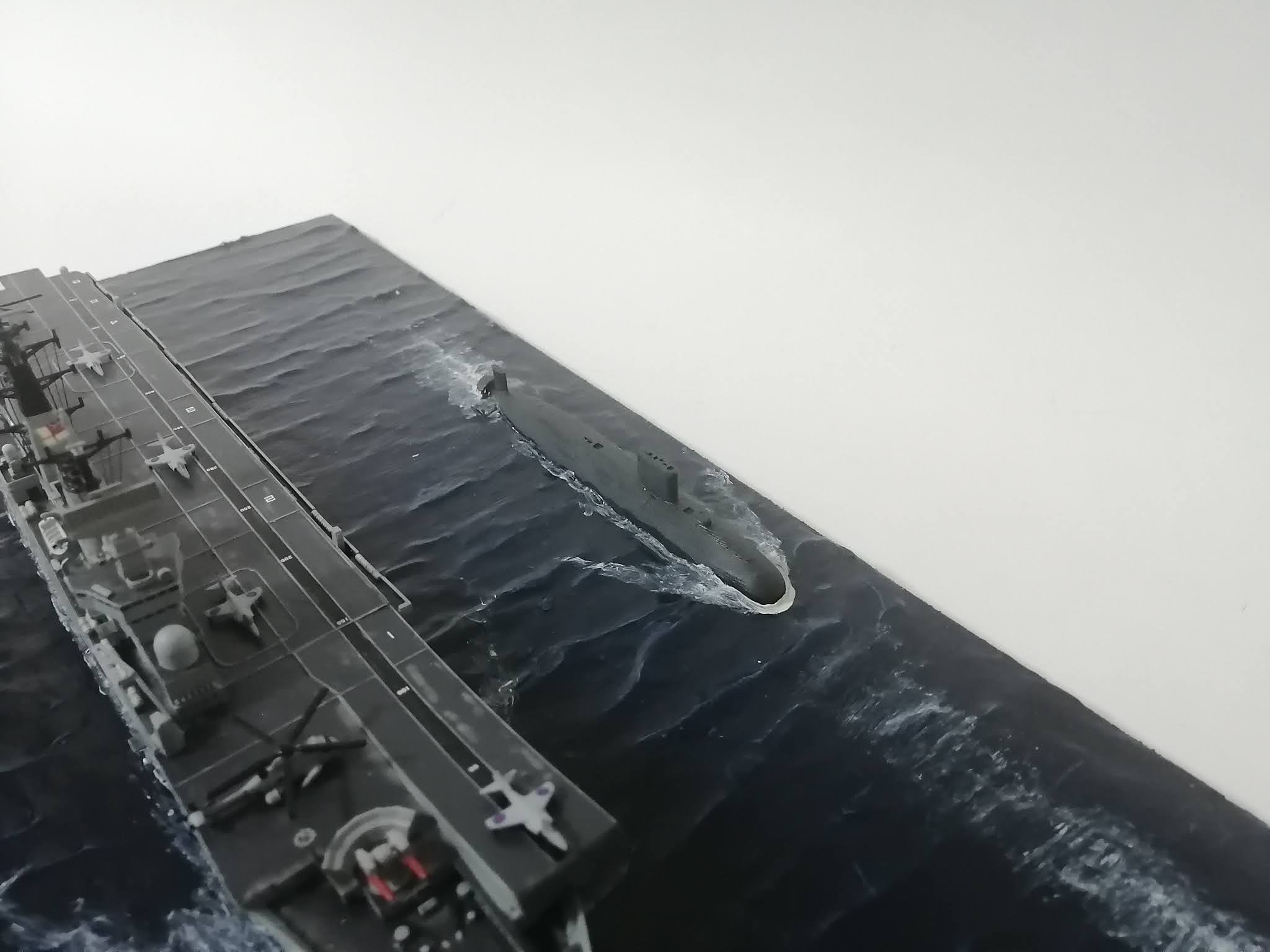
HMS Triumph is a Trafalgar-class nuclear submarine of the Royal Navy and was the seventh and final boat of her class. She is the nineteenth nuclear-powered hunter-killer submarine built for the Royal Navy. Triumph is the tenth vessel, and the second submarine to bear the name. The first HMS Triumph was a 68-gun galleon built in 1561.
Triumph was laid down in 1987 by Vickers Shipbuilding and Engineering Limited. One year previously, a mistake by senior management and changing shipbuilding methods meant that the Vickers shipyard in Barrow-in-Furness accidentally welded part of the submarine in an upside-down position. This was later corrected, and the ship was launched in February 1991 by Mrs. Ann Hamilton, wife of the then Armed Forces Minister Archie Hamilton. She was commissioned in October that same year.
In 2005, Triumph began a £300 million nuclear refuel and refitting period which also saw the installation of an updated 2076 bow, flank and towed array sonar and a new command and control system. The boat rejoined the fleet in June 2010 and is due to be the last of the Trafalgar-class submarines to be decommissioned. Following the Integrated Review of 2020, her service has been extended by 18 months, now scheduled for the end of 2024.
Triumph is due to move to Her Majesty's Naval Base Clyde in 2020.
Triumph sailed to Australia in 1993, travelling 41,000 miles (66,000 km) submerged without support—the longest solo deployment so far by a Royal Navy nuclear submarine. In that same year, author Tom Clancy published a book called Submarine: a Guided Tour Inside a Nuclear Warship which was centred around Triumph and USS Miami.
After the 9/11 attacks in the USA, Triumph, along with her sister-ship Trafalgar, formed part of a task group in 2001 as part of the American-led invasion of Afghanistan, Britain's contribution being known as Operation Veritas.
During Operation Veritas, Triumph launched Tomahawk missiles at targets inside Afghanistan. When Triumph returned home after operations had ended, the boat flew the Jolly Roger, the traditional way of denoting live weapons had been fired.
On 19 November 2000, Triumph ran aground travelling at 22 knots (41 km/h; 25 mph) and at a depth of 200 metres while off the western Scottish coast. The boat surfaced in a safe and controlled fashion. She was under the command of trainee officers and an investigation attributed the grounding to poor navigation. Triumph suffered only superficial damage.
Triumph was also featured in the TV programme "How to Command a Nuclear Submarine" in 2011 in which trainee commanding officers are shown on the Navy's "Perisher Course".
In March 2011, she participated in Operation Ellamy, firing Tomahawk cruise missiles on 19 March 20 March and again on 24 March at Libyan air defence targets. One of these strikes hit a command and control centre in Colonel Gaddafi's presidential compound. Triumph returned to Devonport on 3 April 2011 flying a Jolly Roger adorned with six small tomahawk axes to indicate the missiles fired by the submarine in the operation.
Eleven weeks later on 20 June upon her return to Devonport, in the interim having deployed for a second deployment in the Mediterranean and relieving HMS Turbulent, she once again flew the Jolly Roger adorned with tomahawks, indicating that further cruise missile strikes had taken place in Libya as part of the ongoing operations there. Analysts believe that in total more than 15 cruise missiles were fired by the submarine during the operations.
In November 2011, Triumph sailed from her home port in Devonport for a seven-month deployment that will see her away from the UK until summer 2012. The deployment will see her operate in a wide range of locations including the Atlantic, the Mediterranean, the Arabian Sea and the Indian Ocean.
It was reported in May 2013 that her refit was completed and that she has returned to operational duties.
General characteristics [1]
Class and type:Trafalgar-class submarine
Displacement:
Surfaced: 4,500 to 4,800 t (4,700 long tons; 5,300 short tons)[2]
Submerged: 5,200 to 5,300 t (5,200 long tons; 5,800 short tons)[2]
Length:85.4 m (280 ft)[2]
Beam:9.8 m (32 ft)[2]
Draught:9.5 m (31 ft)[2]
Propulsion:
1 × Rolls Royce PWR1 nuclear reactor
2 × GEC steam turbines
2 × WH Allen turbo generators; 3.2 MW
2 × Paxman diesel alternators 2,800 shp (2.1 MW)
1 × pump jet propulsor
1 × motor for emergency drive
1 × auxiliary retractable prop
Speed:Over 30 knots (56 km/h), submerged[2]
Range:Unlimited[2]
Complement:130[2]
Electronic warfare
& decoys:
2 × SSE Mk8 launchers for Type 2066 and Type 2071 torpedo decoys
RESM Racal UAP passive intercept
CESM Outfit CXA
SAWCS decoys carried from 2002
Armament:
5 × 21-inch (533 mm) torpedo tubes with stowage for up to 30 weapons:
HMS Trenchant is a Trafalgar-class nuclear-powered fleet submarine of the Royal Navy built by Vickers Shipbuilding, Barrow-in-Furness. Trenchant is in service and is based at HMNB Devonport. She is the third vessel and the second submarine of the Royal Navy to be named for the characteristic of vigour and incisiveness.
The submarine was ordered on 22 March 1983. She was laid down by Vickers Shipbuilding on 28 October 1985, and was launched on 3 November 1986 in the presence of Vice Admiral Sir Arthur Hezlet, who had commanded the World War II T-class submarine Trenchant. She was commissioned into the Royal Navy on 14 January 1989.
Following the Integrated Review of 2020, Trenchant is now scheduled to decommission by the end of 2021.
On 22 November 1990, the nets of the fishing vessel Antares were snagged by Trenchant in the Bute Sound in Scotland. At the time the submarine was conducting a 'Perisher' Submarine Command Course exercise in company with the frigate HMS Charybdis. Antares was pulled under with the loss of all four members of the crew.
In July 1997, the submarine ran aground off the western coast of Australia.[8] While approaching Fremantle, Western Australia, the submarine remained at a depth of 200 metres (660 ft) and grounded when she made contact with the continental shelf, coming to rest on a sloping patch of seafloor. Trenchant was able to free herself, and an inspection by divers reported no significant damage.
Trenchant tested the non-hull-penetrating optronic mast in 1998. She also trialled a camouflage paint scheme comprising jagged shapes of various colours, including pale blue.
On 21 June 2007, the submarine became the first Royal Navy vessel to fire the new Block IV Tomahawk cruise missile in a live-firing trial in the Gulf of Mexico off the United States coast.
In late 2009, Trenchant entered the Devonport submarine refit complex to undertake a 2-year refit and upgrade programme. Upon completion of the programme, the submarine underwent a rededication service on 6 June 2011 to welcome the boat back to active service.
On 22 May 2013, Trenchant completed the longest patrol ever carried out by a Royal Navy SSN. The patrol lasted 335 days (11 months) during which the submarine sailed 38,800nm. During this time the vessel has visited six different ports: Fujairah, UAE; the British Indian Ocean Territory – Diego Garcia; the Kingdom of Bahrain; Aqaba, Jordan; Souda Bay, Crete; and Gibraltar.
Following a maintenance period involving a weapon and sensors upgrade, Trenchant returned to service in August 2016.
In March 2018, Trenchant, along with American submarines USS Connecticut and USS Hartford, participated in ICEX 2018, surfacing through the Arctic ice. This was the first time a Royal Navy submarine participated in ICEX since 2007.
In April 2020 a Royal Navy investigation was opened into videos of sailors having a party while under lockdown. The submarine had returned to Devonport for repairs and the crew were required to stay on board in isolation while repairs were completed because of COVID-19 restrictions. It was confirmed that some sailors were drinking alcohol and it was reported that the captain had approved the party despite being advised that it might be inappropriate. The captain was sent home and later relieved of his command, and moved to another role within the Navy.
General characteristics
Class and type:Trafalgar-class submarine
Displacement:
Surfaced: 4,500 to 4,800 t (4,700 long tons; 5,300 short tons)[1]
Submerged: 5,200 to 5,300 t (5,200 long tons; 5,800 short tons)[1]
Length:85.4 m (280 ft)[1]
Beam:9.8 m (32 ft)[1]
Draught:9.5 m (31 ft)[1]
Propulsion:
1 × Rolls Royce PWR1 nuclear reactor
2 × GEC steam turbines
2 × WH Allen turbo generators; 3.2 MW
2 × Paxman diesel alternators 2,800 shp (2.1 MW)
1 × pump jet propulsor
1 × motor for emergency drive
1 × auxiliary retractable prop
Speed:Over 30 knots (56 km/h), submerged[1]
Range:Unlimited[1]
Complement:130[1]
Electronic warfare
& decoys:
2 × SSE Mk8 launchers for Type 2066 and Type 2071 torpedo decoys
RESM Racal UAP passive intercept
CESM Outfit CXA
SAWCS decoys carried from 2002
Armament:
5 × 21-inch (533 mm) torpedo tubes with stowage for up to 30 weapons:
HMS Talent is the sixth of seven Trafalgar-class nuclear submarines of the Royal Navy, and was built at Barrow-in-Furness. Talent was launched by The Princess Royal in April 1988 and commissioned in May 1990. The boat is affiliated with Shrewsbury in Shropshire. Talent is the third submarine of the Royal Navy to bear the name. The first was the World War II Talent, a T-class submarine transferred to the Royal Netherlands Navy as RNLMS Zwaardvisch in 1943.
Talent moved her base from Devonport to Her Majesty's Naval Base Clyde in July 2019.
Following the Integrated Review of 2020, Talent is scheduled to be decommissioned by the end of 2022 and will be replaced by one of the new Astute-class submarines.
Talent undertook a refit at her base port in HMNB Devonport and in March 2007 rejoined the active fleet, following a £386 million upgrade. She has been given a new reactor core and has been equipped with a new sonar suite, Sonar 2076. Sonar 2076 has the power equivalent to approximately 400 PCs and can precisely track the movement of small objects from hundreds of miles away. The Royal Navy describe Sonar 2076 as the most advanced sonar in service with any navy in the world. She has also been given the ability to fire Tomahawk cruise missiles.
On 6 August 2013, she returned to Plymouth after a 3-month deployment.[4] In October 2013, she conducted an anti-submarine exercise with HMS Dragon (D35), USS Gravely (DDG-107), USS Stout (DDG-55) and USS Barry (DDG-52).
In 2009, she suffered loss of primary and alternative power supplies to her nuclear reactors.
She was reported in April 2015 to have struck ice some time in 2014 while tracking Russian vessels.
Although originally scheduled for decommissioning in 2021, the slow delivery of the Astute-class boats will see Talent retained in service for at least an additional 12 months, with her planned out of service date extended to the end of 2022.
General characteristics
Class and type:Trafalgar-class submarine
Displacement:
Surfaced: 4,500 to 4,800 t (4,700 long tons; 5,300 short tons)[1]
Submerged: 5,200 to 5,300 t (5,200 long tons; 5,800 short tons)[1]
Length:85.4 m (280 ft)[1]
Beam:9.8 m (32 ft)[1]
Draught:9.5 m (31 ft)[1]
Propulsion:
1 × Rolls Royce PWR1 nuclear reactor
2 × GEC steam turbines
2 × WH Allen turbo generators; 3.2 MW
2 × Paxman diesel alternators 2,800 shp (2.1 MW)
1 × pump jet propulsor
1 × motor for emergency drive
1 × auxiliary retractable prop
Speed:Over 30 knots (56 km/h), submerged[1]
Range:Unlimited[1]
Complement:130[1]
Electronic warfare
& decoys:
2 × SSE Mk8 launchers for Type 2066 and Type 2071 torpedo decoys
RESM Racal UAP passive intercept
CESM Outfit CXA
SAWCS decoys carried from 2002
Armament:
5 × 21-inch (533 mm) torpedo tubes with stowage for up to 30 weapons:
HMS Invincible was the Royal Navy's lead ship of her class of three light aircraft carriers. She was launched on 3 May 1977 as the seventh ship to carry the name. She was originally designated as an anti-submarine warfare carrier, but was used as an aircraft carrier during the Falklands War, when she was deployed with HMS Hermes. She took over as flagship of the British fleet when Hermes was sold to India. Invincible was also deployed in the Yugoslav Wars and the Second Gulf War (Iraq War). In 2005, she was decommissioned, and was eventually sold for scrap in February 2011.
As built, Invincible was 677 feet (206.3 m) long overall and 632 feet (192.6 m) between perpendiculars, with a beam of 90 feet (27.4 m) at the waterline and 115 feet (35.1 m) at flight deck level, and a draught of 24 feet (7.3 m) at full load. Displacement was 16,000 long tons (16,000 t) standard and 19,500 long tons (19,800 t) full load.[6] The ship was powered by four Rolls-Royce Olympus TBM3 gas turbines, with a maximum total continuous power of 94,000 shaft horsepower (70,000 kW). These drove two propeller shafts via reversible gearboxes, giving a maximum speed of 28 knots (32 mph; 52 km/h). The ship had a range of 5,000 nautical miles (5,800 mi; 9,300 km) at 18 knots (21 mph; 33 km/h).
Invincible's flight deck was 550 feet (167.6 m) long and 55 feet (17 m) wide. It was connected to the ship's hangar by two lifts, with dimensions of 54 feet 8 inches (16.66 m) × 31 feet 8 inches (9.65 m) and rated to carry aircraft with a weight of 35,000 pounds (15,900 kg). The hangar itself was 500 feet (152.4 m) long, with width varying between 74 and 40 feet (22.6 and 12.2 m) and a height of 20 feet (6.1 m). An upward-curved ski-jump ramp at an angle of 6.5 degrees was fitted at the forward end of the ship's flight deck, this allowed the carrier's Sea Harriers to take off with a higher disposal payload, while shortening the take-off run, leaving more space for helicopter operations. The ship had a design air wing of 10 Westland Sea King anti-submarine helicopters and 8 British Aerospace Sea Harrier STOVL jet fighters.
As built, defensive armament consisted of a twin Sea Dart surface to air missile launcher in the ship's bows. 22 Sea Dart missiles were carried. A Type 1022 long-range air-search radar was mounted above the ship's bridge, with Type 909 fire control directors for the Sea Dart system mounted at the fore and aft end of the ship's superstructure. A Type 992 air-surface search radar was mounted on the ship's mainmast, while a Type 1006 navigation radar was also fitted. Type 184 medium range sonar was also fitted.
In September 1982, after returning from the Falklands War, Invincible had her close-in armament supplemented by two Phalanx CIWS and two Oerlikon 20 mm anti-aircraft autocannons. She underwent a major refit in 1986–1989, with several changes to increase the ship's efficiency in operating aircraft. The angle of the ship's ski-jump was increased to 12 degrees, with her hangar modified to allow more aircraft (nine Sea Harriers and twelve Sea Kings) to be accommodated below. The ship's overall length increased to 685.8 feet (209.0 m). Additional command facilities were fitted and accommodation for another 120 people (aircrew and command staff) was added. The ship's magazines were enlarged, allowing Sea Eagle anti-ship missiles for the carrier's Sea Harriers to be carried, while also increasing the number of torpedoes carried for the ship's helicopters. Three Thales 30 mm Goalkeeper CIWS replaced the Phalanxes. Type 996 air-sea search radar replaced the Type 992 radar, with Type 2016 sonar replaced the Type 184. In 2000, Invincible was subject to further modifications to allow her to operate Harrier GR.7s in the ground-attack role. The Sea Dart launcher was removed, while the ship's flight deck was enlarged.
Invincible was ordered from Vickers Shipbuilding and Engineering on 17 April 1973, and was laid down at Vickers' Barrow-in-Furness on 17 April 1973. The ship's construction was delayed by design changes and industrial action, and Invincible was not launched until 3 May 1977. She was accepted into Royal Navy service on 19 March 1980 and after trials, formally commissioned on 11 July 1980. More trials and work-up followed for the ship and her air wing followed before she was declared operational on 19 June 1981, joining the fleet's other carrier Hermes in service.
Invincible's initial air wing consisted of 801 Naval Air Squadron, equipped with five Sea Harriers and 820 Naval Air Squadron, equipped with Sea King anti-submarine helicopters. In August–September 1981, Invicible took part in the NATO naval exercises "Ocean Venture" and "Ocean Safari".
On 25 February 1982, after several months of negotiations, the Australian government announced that it had agreed to buy Invincible for £175 million (285 million A$)[b] as a replacement, under the name HMAS Australia, for the Royal Australian Navy's HMAS Melbourne. Australia planned to make minimal changes to the carrier, adding more fuel and replacing some of the ship's computers. Initially at least, it was planned to operate helicopters only. The sale was confirmed by the Ministry of Defence.
On 2 April 1982, however, Argentina invaded the Falkland Islands. Three days later, a naval task force headed by Invincible and Hermes left HMNB Portsmouth bound for the South Atlantic. On 20 April, the UK government formally ordered its defence forces to bring the islands back under British control. Along with eight Sea Harriers, Invincible's airgroup included twelve Sea King helicopters that were slightly larger than the ship had originally been designed to accommodate. Small machine guns were added around the flight deck and island for close-in defence.
On 23 April, while en route from Ascension Island to the Falklands, Invincible mistakenly locked her Sea Darts on a VARIG Brazilian Airlines DC-10 rather than on the Argentine Air Force Boeing 707 that had been monitoring the fleet's movements. The previous day, Task Group Commander Rear Admiral Sandy Woodward had sought permission from Commander-in-Chief Admiral Sir John Fieldhouse to shoot down the 707 as he believed its activity indicated a raid would be launched from the Argentine aircraft carrier ARA Veinticinco de Mayo. As the 707 would be no direct threat to the fleet, Woodward ordered Weapons Tight and the continued tracking of the aircraft's course while a Sea Harrier was dispatched to investigate. The Harrier pilot reported that "it was a Brazilian airliner, with all the normal navigation and running lights on."
On 30 May, two Super Étendards, one carrying Argentina's last remaining air-launched Exocet, escorted by four A-4C Skyhawks each with two 500 lb (230 kg) bombs, took off to attack Invincible. Argentine intelligence had sought to determine the position of the carriers from analysis of aircraft flight routes from the task force to the islands. However, the British had a standing order that all aircraft conduct a low level transit when leaving or returning to the carriers to disguise their position. This tactic compromised the Argentine attack, which focused on a group of escorts 40 miles south of the main body of ships. Two of the attacking Skyhawks were shot down by Sea Darts fired by HMS Exeter, with HMS Avenger claiming to have shot down the missile with her 4.5" gun (although this claim is disputed). No damage was caused to any British vessels. During the war Argentina claimed to have damaged the ship and continues to do so to this day, although no evidence of any such damage has been produced or uncovered.
On 1 June, the Australian Prime Minister, Malcolm Fraser, advised the British government that the sale of Invincible to Australia could be cancelled if desired. In July 1983, a year after the end of the Falklands conflict, the Ministry of Defence announced that it had withdrawn its offer to sell Invincible so it could maintain a three-carrier force.
In December 1983, Invincible was refused the use of dry dock facilities in Sydney when the Royal Navy declined to divulge to the Australian authorities whether or not the ship was carrying nuclear weapons.
Between 1993 and 1995, Invincible was deployed in the Adriatic for Operation "Deny Flight" and then Operation "Deliberate Force" during the Yugoslav Wars. In 1997, flying the flag of Rear-Admiral Alan West, Commander UK Task Group, Invincible led a deployment that included 3 Commando Brigade Royal Marines. During the following two years, Invincible contributed to Operation "Bolton" (part of Operation "Southern Watch") in southern Iraq before she was redeployed to the Balkans to support the NATO action against Yugoslavia over Kosovo. There, while her helicopters aided refugees, her Harriers were involved in military strikes.
In 2003, Invincible featured in a skit of the BBC show Top Gear involving The Stig racing a white Jaguar XJS on the deck in an attempt to reach 100 mph and stop before the end of the runway. The attempt failed, resulting in The Stig and the Jaguar ending up in the sea.
On 6 June 2005, the British Ministry of Defence announced that Invincible would be inactive until 2010 but available for reactivation at eighteen months' notice. She was decommissioned on 3 August 2005, twenty months after an extensive refit that had been intended to give her ten more years of service. Illustrious succeeded her as the service's flagship. The Royal Navy maintained that Invincible could have been deployed had the need arisen and that Navy policy assumed she was still an active aircraft carrier. According to Jane's, however, Invincible had been stripped of some parts for her sister ships, so operational readiness would require not only eighteen months but also the replacement or removal of systems from those other ships.
In March 2010, Invincible was tied up and minimally maintained with other decommissioned ships up-river of HMNB Portsmouth. On 10 September 2010, she was struck off the Naval Reserve List[36] and, in December, offered for sale by the Disposal Services Authority (DSA) with tenders due by 5 January 2011. The DSA tender documents confirmed that the ship's engines had been removed and that its generators and pumps were "generally unserviceable or not working". On 8 January 2011, the British press relayed an earlier report in the South China Morning Post that a £5-million bid had been made for the ship by the UK-based Chinese businessman Lam Kin-bong with plans to moor her at Zhuhai or Liverpool as a floating international school. In light, however, of China's re-arming of the Varyag – bought under a similar pretext – and the EU arms embargo on China, doubts were raised as to whether such a sale would go ahead.
A month later, in February 2011, BBC News reported that the Ministry of Defence had announced the sale of Invincible to Leyal Ship Recycling in Turkey. She was towed out of Portsmouth on 24 March and arrived at Leyal's Aliağa yard on 12 April 2011 for scrapping.
Invincible initially lacked any close-in weapon systems. As one of the lessons from the Falklands War Invincible had two 20 mm Raytheon Phalanx close-in weapon systems fitted but these were later replaced by three Thales 30 mm Goalkeeper CIWS; there are also two Oerlikon 20 mm cannons. Countermeasures were provided by a Thales jamming system and ECM system, Seagnat launchers provide for chaff or flare decoys. Initially the carriers were armed with a Sea Dart missile system, but this was removed to enlarge the flight deck and to allow magazine storage and deck space for Royal Air Force Harrier GR7s.
After the various refits, the carrier's air group grew from the original planned 5 Sea Harriers and 9 Sea Kings to nine Sea Harrier or Harrier GR7/9s and twelve helicopters (usually all Sea Kings, either anti-submarine warfare (ASW) or Airborne Early Warning (AEW) variants). Alternative airgroups were occasionally tested with 16 Harriers and 3 helicopters being embarked. The carrier was equipped with flagship facilities and could provide an operational headquarters for Royal Navy task forces. The runway was 170 metres (560 ft) long and included the ship's characteristic ski jump (initially at an angle of 7°, but later increased to 12°).
General characteristics
Class and type:Invincible-class aircraft carrier
Displacement:
16,000 t (16,000 long tons) (light)[3]
22,000 t (22,000 long tons) fully loaded
Length:689 ft (210 m)
Beam:118.1 ft (36.0 m)
Draught:28.9 ft (8.8 m)
Propulsion:
4 × Rolls-Royce Olympus TM3B gas turbines providing 97,000 hp (72,000 kW)
HMS Southampton was a batch two Type 42 destroyer of the Royal Navy. She was named after the city of Southampton, England, and built by Vosper Thornycroft, in Southampton. She was the sixth Royal Navy ship to bear the name.
In 1982, she ran over one of the Shambles Buoys off Portland during the final Thursday War intended to prepare her to deploy to the Falklands. The collision sank the buoy and resulted in a period in dry dock for repair.
On 3 September 1988, whilst serving on the Armilla Patrol, she was involved in a collision with MV Tor Bay, a container ship in the convoy being escorted through the Straits of Hormuz. Three members of her crew were slightly injured and a 10 m hole torn in Southampton's hull. She was returned to the UK aboard a semi-submersible heavy lift ship.
In 1998 she was refurbished and her vertiflo system upgraded from hydraulic to electric by PPHS with their engineer John Williamson overseeing the alterations
On 3 February 2006, the ship was involved in the seizing of 3.5 tonnes of cocaine in the Caribbean.
On 31 July 2008, she was placed in a state of "Extended Readiness" and she was decommissioned on 12 February 2009. The ship was auctioned on 28 March 2011 and was later towed from Portsmouth on 14 October 2011 to Leyal Ship Recycling's scrapyard in Aliaga, Turkey.
General characteristics
Class and type:Type 42 destroyer
Displacement:4,820 tonnes
Length:125 m (410 ft)
Beam:14.3 m (47 ft)
Propulsion:
COGOG (Combined gas or gas) turbines, 2 shafts
2 Olympus Gas Turbines Producing 25,000 shp (19,000 kW) each, 2 Tyne Gas Turbines Producing 5,000 shp (3,700 kW) each
HMS Turbulent was a Trafalgar-class submarine of the Royal Navy and the second vessel of her class. Turbulent was the fifth vessel, and second submarine, of the Royal Navy to bear this name. She was built by Vickers Shipbuilding, Barrow-in-Furness, and based at HMNB Devonport. She was commissioned in 1984 and decommissioned in July 2012; she is now being stripped of equipment and will await dismantling in number 3 Basin at Devonport.
Originally intended to hunt down Soviet missile submarines, after the end of the Cold War she spent more time on intelligence gathering missions and landing commando units, as well as firing Tomahawk missiles during the 2003 Iraq war.
Turbulent undertook a modernisation program and first nuclear refuelling in 1997.
Turbulent took part in the 2003 invasion of Iraq, firing thirty Tomahawk cruise missiles during the campaign. On 16 April 2003 she was the first Royal Navy vessel to return home from the war. Turbulent arrived in Plymouth flying the Jolly Roger, a tradition in the Royal Navy signifying having fired weapons in anger.
Turbulent left Devonport in February 2011 for a 268-day deployment East of Suez, which was due to be her final before decommissioning. The deployment saw her operating in the Gulf of Sidra relieving HMS Triumph as part of the British contribution to the Libya intervention. She was then herself relieved by Triumph, before heading through the Suez Canal in June to take up patrol in the Indian Ocean. The boat called into the port of Fujairah, where she rendezvoused with the support ship RFA Diligence. Turbulent returned to Devonport on 14 December 2011, having spent 190 days of her 267-day deployment underwater and travelling more than 38,000 miles A documentary called Royal Navy Submarine Mission on Channel 5 featured Turbulent during this 2011 deployment.
During this deployment, just after sailing from Fujairah on 26 May, Turbulent suffered a catastrophic failure of her air-conditioning systems, while on the surface. Internal temperatures quickly rose to 60 °C with 100° humidity, and caused 26 casualties, mainly from heat exhaustion, eight of which were life-threatening.[clarification needed] With ambient temperatures in the Indian Ocean at 42 °C, surface ventilation was ineffective and the submarine was only effectively cooled by diving to 200 metres. The cause was later found to be blockage of water inlet pipes by barnacles during an extended stay at Fujairah. The incident was only made public in 2014.
Turbulent was scheduled to be decommissioned at the end of 2011. In February 2012 it was reported that either Turbulent or HMS Tireless was being deployed to the Falkland Islands amid increasing tension between Argentina and the United Kingdom over sovereignty of the islands. Commander Nick Wheeler took command in December 2011 until decommissioning on 14 July 2012. She is now being stripped of equipment and will await dismantling in 3 Basin at Devonport Dockyard, Plymouth.
Class and type:Trafalgar-class submarine
Displacement:
Surfaced: 4,500 to 4,800 t (4,700 long tons; 5,300 short tons)[3]
Submerged: 5,200 to 5,300 t (5,200 long tons; 5,800 short tons)[3]
Length:85.4 m (280 ft)[3]
Beam:9.8 m (32 ft)[3]
Draught:9.5 m (31 ft)[3]
Propulsion:
1 × Rolls Royce PWR1 nuclear reactor
2 × GEC steam turbines
2 × WH Allen turbo generators; 3.2 MW
2 × Paxman diesel alternators 2,800 shp (2.1 MW)
1 × pump jet propulsor
1 × motor for emergency drive
1 × auxiliary retractable prop
Speed:Over 30 knots (56 km/h), submerged[3]
Range:Unlimited[3]
Complement:130[3]
Electronic warfare
& decoys:
2 × SSE Mk8 launchers for Type 2066 and Type 2071 torpedo decoys
RESM Racal UAP passive intercept
CESM Outfit CXA
SAWCS decoys carried from 2002
Armament:
5 × 21-inch (533 mm) torpedo tubes with stowage for up to 30 weapons:
HMS Torbay was a Trafalgar-class nuclear submarine of the Royal Navy and the fourth vessel of her class. Torbay is the fifth vessel and the second submarine of the Royal Navy to be named after Torbay in Devon, England. The first vessel was the 80-gun second rate HMS Torbay launched in 1693.
Torbaywas the first vessel to be fitted with the new command system SMCS-NG and therefore the first British warship to be controlled using the Microsoft Windows operating system.
Torbay was scheduled to be decommissioned in 2015 and will be replaced by one of the new Astute-class submarines. As of November 2013 she is still undergoing extended maintenance and upgrades, which were originally scheduled to complete in summer 2013. The work allows for a life extension beyond the previously-planned decommissioning date. On 6 June 2017, HMS Torbay entered Gibraltar Naval Base flying her paying-off pennant. On Friday 14 July 2017, HMS Torbay was decommissioned in Devonport.
Torbay completed a refuel and modernisation process in February 2001.
In early 2006, Torbay was the participant in an experiment in the use of colour schemes to reduce the visibility of submarines from the air. The standard black paint of Royal Navy submarines was replaced by a carefully selected shade of blue. This was the result of research that found that black was the worst possible colour for a submarine attempting to avoid detection from the air. This change is in part the result of the changing nature of Royal Navy commitments since the end of the Cold War, with Navy operations moving from the murky waters of the North Atlantic to the clearer waters of the Arabian Sea and the Indian Ocean.
In November 2010, it was reported in Hansard that Torbay had run aground in the Eastern Mediterranean in April 2009.
I May 2011, she took part in Exercise Saxon Warrior in the Western Approaches. The exercise included the aircraft carrier USS George H.W. Bush, HMS Dauntless, HMS Westminster, and a number of other vessels and culminated in a "Thursday War".
In late 2011 she entered a revalidation and assisted maintenance period (RAMP) at Devonport Royal Dockyard. This includes communications upgrades with installation of the Cromwell radio antenna to enhance internal communications and the ship alongside upgrade, plus inspection of the hull and reactor, an overhaul of one of the reactor coolers and upgrades to many other systems. As of September 2012 the RAMP was 85% complete, with a return to service originally planned for summer 2013.
In 2013, there was a fire on board.
On 6 June 2017, Torbay entered Gibraltar flying her paying-off pennant; she made her final entry to Devonport on 19 June 2017 prior to her formal decommissioning parade on 14 July 2017.
General characteristics
Class and type:Trafalgar-class submarine
Displacement:
Surfaced: 4,500 to 4,800 t (4,700 long tons; 5,300 short tons)[1]
Submerged: 5,200 to 5,300 t (5,200 long tons; 5,800 short tons)[1]
Length:85.4 m (280 ft)[1]
Beam:9.8 m (32 ft)[1]
Draught:9.5 m (31 ft)[1]
Propulsion:
1 × Rolls Royce PWR1 nuclear reactor
2 × GEC steam turbines
2 × WH Allen turbo generators; 3.2 MW
2 × Paxman diesel alternators 2,800 shp (2.1 MW)
1 × pump jet propulsor
1 × motor for emergency drive
1 × auxiliary retractable prop
Speed:Over 30 knots (56 km/h), submerged[1]
Range:Unlimited[1]
Complement:130[1]
Electronic warfare
& decoys:
2 × SSE Mk8 launchers for Type 2066 and Type 2071 torpedo decoys
RESM Racal UAP passive intercept
CESM Outfit CXA
SAWCS decoys carried from 2002
Armament:
5 × 21-inch (533 mm) torpedo tubes with stowage for up to 30 weapons:
HMS Tireless was the third Trafalgar-class nuclear submarine of the Royal Navy. Tireless is the second submarine of the Royal Navy to bear this name. Launched in March 1984, Tireless was sponsored by Sue Squires, wife of Admiral 'Tubby' Squires, and commissioned in October 1985.
During the Cold War Tireless was primarily involved in anti-submarine warfare patrols in the Atlantic Ocean. After the Cold War, Tireless was deployed around the world, including to the Arctic Ocean, Mediterranean Sea and Pacific Ocean. At the end of its career, Tireless was involved in the search for the missing airliner, Malaysia Airlines Flight 370. The vessel experienced a number of serious accidents during its operational life.
Tireless had been scheduled for retirement during 2013, but its service was extended until eventual decommissioning on 19 June 2014. Tireless was replaced on active duty by HMS Artful.
From commissioning in 1985, Tireless completed numerous exercises and visits around the world, including a trip to the Arctic in 1991, before entering a refit in early 1996, returning to sea in 1999.
In May 2000, Tireless developed a serious leak in the nuclear reactor primary cooling circuit, although there was no leak of radioactive material. The nuclear propulsion system was shut down and using backup diesel power Tireless made way to Gibraltar. The damage was found to be more extensive than first thought, and the boat remained there pending repairs. This created diplomatic tension between Spain and Britain, until the submarine departed on 7 May 2001 after almost a year of extensive repairwork. During that year, all Trafalgar-class submarines were inspected for similar problems.
On 13 May 2003, while on exercise in the Arctic and travelling at a depth of 60 metres, Tireless collided with an iceberg. There was no prior warning of the impending collision from passive sonar or other onboard sensors. The submarine's bow was forced down nine degrees and the vessel subsequently broke free of the iceberg at a depth of 78 metres. Some damage was sustained to the upper section of the boat. Before the incident, the Royal Navy had not conducted under-ice operations since 1996.
On 19 April 2004, Tireless and USS Hampton rendezvoused under the Arctic ice and surfaced together at the North Pole.
Tireless again angered Spain in 2004 when the boat put into Gibraltar from 9 to 15 July for what was explained as "technical reasons." Britain assured Spain that the port call was unrelated to the British celebrations, on 21 July, of the 300th anniversary of Spain handing over Gibraltar to Britain.
In 2007 Tireless ventured to the North Pole with USS Alexandria to participate in the Applied Physics Laboratory Ice Station (APLIS).
On 21 March, two Tireless crew members, Leading Weapons engineer Paul McCann and Weapons engineer 2 Anthony Huntrod (Weapons Submariner) were killed in an explosion on board, apparently caused by an oxygen generator candle in the forward section of the submarine. The boat was in service near the North Pole under ICEX-07 along with the USS Alexandria and had to make an emergency surface through the ice cap. A third crewmember suffered "non life-threatening" injuries and was airlifted to a military hospital at Elmendorf Air Force Base near Anchorage, Alaska. According to the Royal Navy, the accident did not affect the submarine's nuclear reactor, and the boat sustained only superficial damage. Part of the exercise was being used to measure ice thickness by using sonar. The film Stargate: Continuum—which was filming on the ice and in the Alexandria during the exercise—was dedicated to McCann and Huntrod.
From 9 July 2010 to 12 May 2011, Tireless undertook a ten-month deployment, spending 253 days at sea, the longest conducted by a Royal Navy submarine in ten years.[15] During the deployment the boat passed through the Suez Canal for the first time, provided protection for the French aircraft carrier Charles de Gaulle launching aircraft over Afghanistan, and called into the ports of Fujairah in the United Arab Emirates, Goa in India and Souda Bay in Crete. Tireless was also involved in a multi-nation anti-submarine exercise in the Gulf of Oman which saw the Australian frigate HMAS Melbourne and the French frigate FS Dupleix attempt to locate the submarine.
2012 South Atlantic deploymentIn February 2012, it was reported that either Tireless or HMS Turbulent was being deployed to the Falkland Islands amid increasing tension between Argentina and the United Kingdom over sovereignty of the islands.
However HMS Tireless surfaced in Southampton in March before conducting towed array calibration and testing in the Bay of Biscay before returning to Devonport
In early 2013 Tireless experienced a "small coolant leak that was contained within the sealed reactor compartment", requiring a return to HMNB Devonport for repair.
Tireless was spotted off the Rock of Gibraltar amidst the tensions between Spain and the UK over the disputed territory of Gibraltar. It was suggested that this SSN could be a key vessel used to strike Syria if military action occurred.
The submarine conducted operations and was spotted in ports around Goa, UAE and Crete
On 1 April 2014, Tireless arrived in the southern Indian Ocean to join the search for a missing Malaysian airliner, where its sophisticated underwater listening equipment was used in an unsuccessful attempt to detect the underwater locator beacon of the aircraft's flight recorders.[20][21]
On 1 June 2014 Tireless returned to Plymouth for the last time before decommissioning, and was formally decommissioned on 19 June.
Tireless final operations saw visits to Gibraltar, Crete, India, Jordan, UAE and Australia
Tireless was moved on 2020 to the basin within Devonport dockyard, more commonly referred to as “the graveyard”
History
United Kingdom
Name:HMS Tireless
Ordered:5 July 1979
Builder:Vickers Shipbuilding and Engineering, Barrow-in-Furness
Laid down:6 June 1981
Launched:17 March 1984
Sponsored by:Sue Squires
Commissioned:5 October 1985
Decommissioned:19 June 2014
Homeport:HMNB Devonport, Plymouth
Identification:Pennant number: S88
Status:Decommissioned[1]
Badge:HMS Tireless crest.jpg
General characteristics [2]
Class and type:Trafalgar-class submarine
Displacement:
Surfaced: 4,500 to 4,800 t (4,700 long tons; 5,300 short tons)[3]
Submerged: 5,200 to 5,300 t (5,200 long tons; 5,800 short tons)[3]
Length:85.4 m (280 ft)[3]
Beam:9.8 m (32 ft)[3]
Draught:9.5 m (31 ft)[3]
Propulsion:
1 × Rolls Royce PWR1 nuclear reactor
2 × GEC steam turbines
2 × WH Allen turbo generators; 3.2 MW
2 × Paxman diesel alternators 2,800 shp (2.1 MW)
1 × pump jet propulsor
1 × motor for emergency drive
1 × auxiliary retractable prop
Speed:Over 30 knots (56 km/h), submerged[3]
Range:Unlimited[3]
Complement:130[3]
Electronic warfare
& decoys:
2 × SSE Mk8 launchers for Type 2066 and Type 2071 torpedo decoys
RESM Racal UAP passive intercept
CESM Outfit CXA
SAWCS decoys carried from 2002
Armament:
5 × 21-inch (533 mm) torpedo tubes with stowage for up to 30 weapons:
HMS Ark Royal was a light aircraft carrier and former flagship of the Royal Navy. She was the third and final vessel of Invincible class. She was built by Swan Hunter on the River Tyne and launched by them in 1981. Ark Royal was christened by Queen Elizabeth The Queen Mother. She followed sister ships HMS Invincible and HMS Illustrious into service in 1985.
Affectionately known as The Mighty Ark, she is the fifth Royal Navy ship to have borne the name of the 1587 flagship that defeated the Spanish Armada in 1588. Originally intended to be named Indomitable to match the rest of the class, this was changed due to the public reaction to the loss of the Ark Royal name after the scrapping of the previous Ark Royal in 1980, after 30 years' service.
Slightly larger than her sister ships, and with a steeper ski-jump ramp, Ark Royal carried the STOVL (Short Take Off and Vertical Landing) Harrier Jump Jet aircraft, as well as various helicopters. With a crew complement of over 1,000 sailors and aviators, she saw active service in the 1990s Bosnian War and the 2003 Invasion of Iraq.
Originally due to be retired in 2016, Ark Royal was instead decommissioned on 11 March 2011, as part of the Navy restructuring portion of the 2010 Strategic Defence and Security Review. After Ark Royal's decommissioning HMS Albion replaced her as the Royal Navy flagship. Ark Royal was sold for scrap to the Turkish company Leyal Ship Recycling and left Portsmouth in May 2013.
The aircraft carrier's keel was laid by Swan Hunter at Wallsend on 7 December 1978. She was launched on 2 June 1981 sponsored by the Queen Mother and commissioned on 1 November 1985. Originally intended as Indomitable in line with her sister ships Invincible and Illustrious, public resentment at the scrapping of the previous Ark Royal (the UK's last large aircraft carrier up to that date) in 1980 led the Royal Navy to announce that the name would be revived on the new ship. The unfinished Ark Royal was reportedly offered for sale to the Royal Australian Navy in 1981. HMS Invincible was later offered for sale instead.
Ark Royal was deployed in 1993 to the Adriatic Sea during the Bosnian War under the command of Captain Terry Loughran RN (later rear admiral). In May 1999 she put into Rosyth for refitting, which included the removal of the Sea Dart surface-to-air missiles and covering over of the foredeck to allow for an enlarged deck park for aircraft.
She was recommissioned on 22 November 2001 by Queen Elizabeth The Queen Mother. She sailed to the Persian Gulf for the 2003 Invasion of Iraq. Commanded by Captain Alan Massey (later Vice Admiral and Second Sea Lord) and with a complement consisting of helicopters alone rather than her usual mix of helicopters and Harrier aircraft. During operations in the war two Westland Sea King helicopters, from 849 Naval Air Squadron, collided in mid-air with the loss of six British and one American lives. Her deployment to the gulf was filmed throughout by Shine TV for a Channel 5 documentary entitled 'Ark Royal'.
n April 2004 Ark Royal entered into extended readiness, following which she entered refit with the return to service of Illustrious. Ark Royal completed an extensive refit and received a new captain (Captain Mike Mansergh) in August 2006, then returned to Portsmouth, her home port, to rejoin the fleet on 28 October 2006 where she underwent ten weeks of training and sea trials before being utilised as a landing platform helicopter, replacing Ocean while she underwent a refit. On 16 November 2006 a British Army WAH-64 Apache attack helicopter landed on Ark Royal for the first time marking an increase in the carrier's capability.
On 22 March 2007, Ark Royal was returned to the Royal Navy Fleet after a two-year refit worth £18 million. As of May 2007, she once again became the Fleet Flagship, reclaiming the title from her sister ship, Illustrious, which had been flagship since the end of her refit in 2005. On 31 July 2008, Mansergh was relieved as captain by Captain John Clink. In October 2008, Ark Royal was a participant in Exercise Joint Warrior 08-2. In January 2009 Ark Royal visited Liverpool and then the River Tyne, where she was built. Her voyage from Portsmouth to Liverpool was made with 108 Cadets from the Sea Cadet Corps and the Combined Cadet Force embarked.
During the air travel disruption after the 2010 Eyjafjallajökull eruption, the then Prime Minister, Gordon Brown, assigned Ark Royal and Ocean to rescue stranded travellers across the English Channel in Operation Cunningham. In June 2010 Ark Royal was in Halifax, Nova Scotia, to take part in the Royal Canadian Navy Centennial Celebrations, where she was visited by the British Prime Minister, David Cameron, on his way to the G20 summit in Toronto. During this time a V-22 Osprey visited the ship, again increasing its capabilities.
On 19 October 2010, BBC News reported that the ship was to be decommissioned and scrapped earlier than expected, as part of the coalition government's spending review and expected 8% cut to the British defence budget to be announced later that week, to be replaced in the long run with HMS Prince of Wales.A campaign was begun in November 2010 to retain the name Ark Royal for one of the new carriers. On 3 December 2010, the amphibious warfare ship HMS Albion was announced as Ark Royal's successor as the Royal Navy's flagship. In recognition of the ship's decommissioning, Portsmouth F.C. added the ship's motto to its 2011/12 season kit.
On the evening of 19 October, the ship arrived at Portsmouth ready to be decommissioned and laid up. On 5 November she was visited by Queen Elizabeth at Portsmouth before sailing to Loch Long for the removal of all her munitions. She then left the River Clyde on 17 November on her final voyage before decommissioning, visiting North Shields on 18–22 November and Hamburg for five days from 25 November. The latter was her last overseas visit, repeating a previous one in 2007. During the voyage she launched four Harrier GR9s for the last time in the North Sea on 24 November
The ship then sailed from Hamburg back into Portsmouth, arriving at 9.40 am on 3 December 2010 flying a decommissioning pennant, though bad weather prevented a Harrier flypast to mark the occasion. A farewell parade by her captain and crew was held in Guildhall Square in Portsmouth on 22 January 2011 and another in Leeds, the latter being a Freedom of the City parade. Her formal decommissioning occurred at Portsmouth on 11 March 2011. She was then to have sailed to Rosyth or Govan, but instead de-stored at Portsmouth in late March after her decommissioning, with her last crew members leaving her by 25 May.
A Ministry of Defence spokesperson stated on 1 December 2010 that, "All options are being considered in terms of what happens to the Ark Royal after it is decommissioned. We might also look at scrapping it, selling it or recycling it." Other options explored were to moor her as a hotel, casino, museum ship or visitor attraction at the Royal Docks in east London or at Mablethorpe in Lincolnshire, along the lines of USS Intrepid or HMS Belfast. The annual cost of running the ship as a museum was estimated at £1 million. Another option explored was to moor her as a floating helipad in London's Royal Albert Dock, though that would have been against the London Plan to create no new helipads in London. Another option considered was to turn Ark Royal into a hospital ship with the ability to respond to humanitarian disasters. The possibility of scuttling Ark Royal off the Devonshire coast as an artificial reef was also discussed.
On 28 March 2011 the Ministry of Defence placed the decommissioned Ark Royal up for sale by auction, with 6 July as the final date for tenders. In June 2012, the MoD confirmed it had not reached a decision on the sale of the ship, following the submission of bids nearly a year previously. In September 2012, the announcement was made that the ship had been sold to Leyal Ship Recycling in Turkey for scrapping, for the sum of £2.9m. Ark Royal left Portsmouth on 20 May 2013 to be taken to Leyal Ship Recycling. The ship was towed to scrapyard on 10 June 2013 in Aliağa.
Name:Ark Royal
Namesake:The 1587 flagship that defeated the Spanish Armada in 1588, Ark Royal
Ordered:December 1978
Builder:Swan Hunter, Tyne and Wear, United Kingdom
Laid down:14 December 1978
Launched:2 June 1981
Sponsored by:Queen Elizabeth The Queen Mother
Commissioned:1 November 1985
Decommissioned:11 March 2011
Refit:
First Major 1999–2001
Second Major 2004–2007
Homeport:HMNB Portsmouth
Identification:
IMO number: 8949575
Pennant number: R07
International Callsign: GCDG
Deck code: R
Motto:Zeal Does Not Rest
Nickname(s):Noah's Ark
Honours and
awards:Al Faw 2003
Fate:Scrapped in Turkey, June 2013
Badge:Ship's Badge
General characteristics
Class and type:Invincible-class aircraft carrier
Displacement:22,000 tons[5]
Length:210 m (689.0 ft) (689 ft)
Beam:36 m (118.1 ft)
Draught:7.5 m (24.6 ft)
Propulsion:
4 × Rolls-Royce Olympus TM3B gas turbines providing 97,000 hp (72,333 kW)