Showing posts with label 01 Submarine. Show all posts

Friday, July 2, 2021

Uboot U-35

 Scale 1:350 Brand Hobbyboss (Kit score 8/10)


https://www.facebook.com/ericknnavas/

https://www.instagram.com/ships_and_models_by_ericknavas/

German submarine U-35 was a Type VIIA U-boat of Nazi Germany's Kriegsmarine. She was built three years before the start of World War II. The submarine was laid down on 2 March 1936 by Friedrich Krupp Germaniawerft at Kiel, launched on 24 September 1936, and commissioned on 3 November that year under the command of Kapitänleutnant (Kptlt.) Klaus Ewerth. The U-boat was featured on the cover of Life magazine on 16 October 1939, as in the days preceding, it "courteously" rescued all the sailors of a Greek ship that it was about to sink.

U-35 was scuttled just three months into World War II in November 1939. During her service, she conducted two war patrols and sank four vessels for a total loss of 7,850 tons while damaging one vessel of around 6,014 tons.

U-35 was ordered by the Kriegsmarine on 25 March 1935 (technically in violation of the Treaty of Versailles, but consistent with the soon to be signed Anglo-German Naval Agreement). Her keel was laid down on 2 March 1936 by Friedrich Krupp Germaniawerft in Kiel as yard number 558. She was launched on 24 September 1936 and commissioned on 3 November of that year under the command of Kptlt. Klaus Ewerth.

Like all Type VIIA submarines, U-35 displaced 626 tonnes (616 long tons) while surfaced and 745 t (733 long tons) when submerged. She was 64.50 m (211 ft 7 in) in overall length and had a 45.50 m (149 ft 3 in) pressure hull. U-35's propulsion consisted of two MAN 6-cylinder 4-stroke M6V 40/46 diesel engines that totaled 2,100–2,310 PS (1,540–1,700 kW; 2,070–2,280 bhp). Her maximum rpm was between 470 and 485. The submarine was also equipped with two Brown, Boveri & Cie GG UB 720/8 electric motors that totaled 750 PS (550 kW; 740 shp). Their maximum rpm was 322. These power plants gave U-35 a total speed of 17 knots (31 km/h; 20 mph) while surfaced and 8 knots (15 km/h; 9.2 mph) when submerged. This resulted in a range of 6,200 nmi (11,500 km; 7,100 mi) while traveling at 10 knots (19 km/h; 12 mph) on the surface and 73–94 nmi (135–174 km; 84–108 mi) at 4 knots (7.4 km/h; 4.6 mph) when submerged. The U-boat's test depth was 220 m (720 ft) but she could go as deep as 230–250 m (750–820 ft) without having her hull crushed. U-35's armament consisted of five 53.3 cm (21 in) torpedo tubes, (four located in the bow and one in the stern). She could carry up to 11 torpedoes or 22 TMA mines or 33 TMB mines. U-35 was also equipped with a 8.8 cm SK C/35 naval gun and had 220 rounds stowed on board. Her anti-aircraft defenses consisted of one 2 cm (0.79 in) anti-aircraft gun.

Pre-war

U-35 was known as the "bad luck boat" of the 2nd U-Boat Flotilla ("Saltzwedel") due to several accidents. She was rammed by a freighter in 1937, overrun and badly damaged by the pocket battleship Admiral Graf Spee in 1938, and was struck by an aircraft in 1939. She also had some success; U-35 (together with U-28), was the first U-boat to patrol the Atlantic, sailing under the command of Hans-Rudolf Rösing to Ponta Delgada in the Azores. She then undertook several patrols to Spain, Ceuta, Gibraltar and Morocco under the command of Hermann Michahelles and Werner Lott. After the death of Michahelles in a car accident, Otto Kretschmer was briefly given U-35 as his first U-boat command. Before taking over as the temporary skipper, Kretschmer, while serving as the watch officer, was accidentally left on the deck while U-35 dived during maneuvers and nearly drowned. During another peacetime drill in 1938, her sister boat, U-30, was involved in a near-fatal collision with U-35.

Last pre-war patrol

U-35's last pre-war patrol began on 27 August 1939, and took her from Memel (in the Baltic) to Kiel, where she arrived on 1 September, the first day of the invasion of Poland.

First war patrol

The U-boat departed Wilhelmshaven on 9 September 1939. That day, the submarine HMS Ursula fired the first British submarine torpedoes of the war when attacking U-35 about 23 nmi (43 km; 26 mi) north of the Dutch island of Schiermonnikoog. The U-boat escaped without damage and sailed northabout the British Isles to attack shipping.

On 18 September she stopped a group of three fishing trawlers west-north-west of St.Kilda. She sank two with gunfire, the 326-ton Arlita and the 295-ton Lord Minto after confiscating their radios and fishing gear but allowing their crews to evacuate. A third trawler, Nancy Hague, was allowed to proceed after taking on the crews of the other vessels.

After 14:10 on 21 September, U-35 fired three torpedoes at Convoy OA-7 south-west of the Isles of Scilly. She missed a destroyer and a tanker, but damaged the 6,014-ton British tanker Teakwood. The damaged ship was taken to Falmouth in Cornwall, escorted by HMS Ardent. The one sailor killed onboard Teakwood during this attack was the only person to have been killed during World War II in association with U-35.

At 18:45 on 1 October 1939, 42 miles off Ushant, U-35 stopped the unarmed neutral 2,239-ton Belgian merchant ship Suzon, which was carrying 2,400 tons of pit props from Bordeaux to Cardiff. After the crew abandoned ship after an inspection, she was torpedoed and sunk.

Diamantis

About 13:15 on 3 October, 40 miles west of the Scilly Islands, U-35 stopped the 4,990-ton Greek freighter Diamantis, which was taking 7,700 tons of manganese ore from Pepel, Sierra Leone, to Barrow-in-Furness. Like Suzon, she was a neutral, but carrying a strategic cargo to Britain and therefore a "legitimate target". The crew, misunderstanding the U-boat's instructions, abandoned ship prematurely. After two G7a torpedoes exploded prematurely, the ship was sunk by a G7e torpedo. Because the ship's lifeboats were not suited for use in bad weather, Lott decided to take all crew members aboard.

U-35's commander Werner Lott later commented:

In the rough weather I would not have been able to examine the ship's papers, so I gave a signal to follow me. I wanted to go to the Irish coast where I knew there would not be such rough weather. They did not follow me so I fired a shot from my gun at the bow of the boat. This had the result that the crew panicked and jumped into the small boats. One could foresee that with the rough seas that they would overturn.

The next day, 4 October, U-35 was seen by people in Ventry and Ballymore, Co. Kerry easing into the bay. The U-boat launched a dinghy and brought ashore the 28 Greek sailors from Diamantis.

The U-boat returned to Wilhelmshaven on 12 October after 34 days at sea where Lott was reprimanded for his actions, which were regarded as having endangered his crew.

Commemoration

On Saturday, 17 October 2009, more than 200 people attended various celebratory events in Ventry to mark the rescue and landing of the Greek seamen. The occasion was organised by the newly formed Ventry Historical Society.

The main ceremony was held on the green in front of Quinn's Pub, where an inscribed commemorative stone was erected. Guests included the German Ambassador Dr. Busso von Alvensleben and the Mayor of the Oinousses Islands in the Aegean, Evangelos Elias Angelakos, who unveiled the memorial stone. Other guests included descendants of Panagos Pateras, the captain and owner of the ill-fated Diamantis, officers of Southern Command, members of the Irish Coast Guard, the crew of the Valentia lifeboat, and a troop of Sea Scouts from Tralee.

The secretary of the historical society, Dr. Breandán Ó Ciobháin, delivered a welcoming address in Irish, English, Greek, and German, and invited the German ambassador to address the gathering:

I'm deeply moved about this generous gesture of erecting this memorial. In that terrible war, which we all remember very well, it was indeed an exceptional action that we are going to honour today. I'm more than happy that nowadays our three countries are united in the European Union and that we can be sure that anything like that will never occur again. The only thing that should survive is the sense of magnanimity and of courage that will serve as an example for all of us.

Mayor Angelakos said it was a great honor to attend the Ventry ceremony 70 years after the incident: "I would like to remind you of the magnanimous stance of Werner Lott, the commander of the U-35." The occurrence is one of only two such instances in World War II, where a German submarine crew risked its own safety to protect the crew of a vessel they torpedoed and sank.

Second war patrol

U-35 sailed from Wilhelmshaven on her second and final war patrol on 18 November 1939. On 29 November 1939 U-35 was scuttled by its crew in the North Sea, in position 60°53′N 02°47′ECoordinates: 60°53′N 02°47′E, after a depth charge attack from the British destroyers Kingston, Icarus, and Kashmir. Lord Louis Mountbatten, commanding the British squadron, took the extraordinary step of stopping his ships for an extended period of time and sending out boats to rescue the crew of the German submarine adrift in water. Consequently, unusual among U-boats lost during the war, all 43 hands on board survived and were taken prisoner. Indeed, every member of the U-35 crew during its short World War 2 service survived the war.

Summary of raiding history

Date                 Name of Ship Nationality         Tonnage (GRT) Fate

18 September 1939 Arlita         United Kingdom 326                         Sunk

18 September 1939 Lord Minto United Kingdom 295                         Sunk

21 September 1939 Teakwood United Kingdom 6,014                 Damaged

1 October 1939 Suzon         Belgium                 2,239                 Sunk

3 October 1939 Diamantis Greece                 4,990                 Sunk

History

Nazi Germany

Name U-35

Ordered 25 March 1935

Builder Germaniawerft, Kiel

Cost 4,189,000 Reichsmark

Yard number 558

Laid down 2 March 1936

Launched 24 September 1936

Commissioned 3 November 1936

Fate Scuttled, 29 November 1939

General characteristics

Class and type Type VIIA submarine

Displacement

626 tonnes (616 long tons) surfaced

745 t (733 long tons) submerged

Length

64.51 m (211 ft 8 in) o/a

45.50 m (149 ft 3 in) pressure hull

Beam

5.85 m (19 ft 2 in) o/a

4.70 m (15 ft 5 in) pressure hull

Height 9.50 m (31 ft 2 in)

Draught 4.37 m (14 ft 4 in)

Installed power

2,100–2,310 PS (1,540–1,700 kW; 2,070–2,280 bhp) (diesels)

750 PS (550 kW; 740 shp) (electric)

Propulsion

2 shafts

2 × diesel engines

2 × electric motors

Range

6,200 nmi (11,500 km; 7,100 mi) at 10 knots (19 km/h; 12 mph) surfaced

73–94 nmi (135–174 km; 84–108 mi) at 4 knots (7.4 km/h; 4.6 mph) submerged

Test depth

220 m (720 ft)

Crush depth: 230–250 m (750–820 ft)

Complement 4 officers, 40–56 enlisted

Sensors and

processing systems Gruppenhorchgerät

Armament

5 × 53.3 cm (21 in) torpedo tubes (four bow, one stern)

11 × torpedoes or 22 TMA mines

1 × 8.8 cm (3.46 in) deck gun (220 rounds)

1 × 2 cm (0.79 in) C/30 anti-aircraft gun

Service record[1][2]

Part of:

2nd U-boat Flotilla

3 November 1936 – 29 November 1939

Identification codes: M 21 203

Commanders:

Kptlt. Klaus Ewerth

3 November – 5 December 1936

Kptlt. Hans Rudolf Rösing

6 December 1936 – February 1937

Kptlt. Hermann Michahelles

February – 30 July 1937

Oblt.z.S. Otto Kretschmer

31 July – 15 August 1937

Kptlt. Werner Lott

15 August 1937 – 29 November 1939

Operations:

last prewar patrol: 27 August – 1 September 1939

1st war patrol: 9 September – 12 October 1939

2nd war patrol: 18 – 29 November 1939

Victories:

Four commercial ships sunk (7,850 GRT)

One commercial ship damaged (6,014 GRT)


Thursday, July 1, 2021

Submarine S-181 U-31

 Scale 1:350 Brand Hobbyboss (Kit Score 9/10)


https://www.facebook.com/ericknnavas/

https://www.instagram.com/ships_and_models_by_ericknavas/

U-31 (S181) is a Type 212A submarine of the German Navy, and the lead ship of her class.

U-31 was built by TKMS, with construction taking place at the shipyards of Thyssen Nordseewerke of Emden and Howaldtswerke at Kiel. Launched on 20 March 2002, U-31 was commissioned alongside her sister ship U-32 by German Minister of Defence Peter Struck in Eckernförde on 19 October 2005. U-31 is propelled by one diesel engine and an electric motor driven by nine fuel cells, making the submarine virtually undetectable.

Korvettenkapitän Bert Petzold is the submarine's commanding officer.

History

U-31 was built in two sections, the stern and propulsion by Nordseewerke, Emden and the bow at Howaldtswerke-Deutsche Werft, Kiel. The boats of the Type 212A class cost around 500 million euros to build. Equipped with fuel cell technology and stealth skin, they are almost undetectable, and are able to remain submerged for up to three weeks . The fuel cells are virtually emission free, with the exception of distilled water, resulting in less noise, heat and exhaust fumes.

U-31 and U-32 were commissioned in a joint ceremony at Eckernförde on 19 October 2005 by Defence Minister Peter Struck, in the presence of the Inspector of the Navy Vice- Admiral Wolfgang E. Nolting. They and their sister ships are stationed in Eckernförde and form part of the 1st Ubootgeschwader (1st Submarine Squadron) in Einsatzflottille 1.

History

Germany

Name U-31

Builder

Nordseewerke, Emden

Howaldtswerke, Kiel

Launched 20 March 2002

Commissioned 19 October 2005

Status in service.

Class and type Type 212A

General characteristics

Class and type Type 212

Type submarine

Displacement

1,450 tonnes (1,430 long tons) surfaced

1,830 tonnes (1,800 long tons) submerged

Length

56 m (183.7 ft)

57.2 m (187.66 ft) (2nd batch)

Beam 7 m (22.96 ft)

Draft 6 m (19.68 ft)

Installed power 1 x MTU-396 16V (2,150 kW); 1 x Siemens Permasyn electric motor Type FR6439-3900KW (2,850 kW)

Propulsion

1 MTU 16V 396 diesel-engine

9 HDW/Siemens PEM fuel cells, 30–40 kW each (U31)

2 HDW/Siemens PEM fuel cells each with 120 kW (U32, U33, U34)

1 Siemens Permasyn electric motor 1700 kW, driving a single seven-bladed skewback propeller

Speed 20 knots (37 km/h) submerged, 12 knots surfaced

Range

8,000 nmi (14,800 km, or 9,196 miles) at 8 knots (15 km/h) surfaced

3 weeks without snorkeling, 12 weeks overall

Endurance Surface 14,800 km at 15 km/h, Subsurface 780 km at 15 km/h, 3,000 nmi at 4 kn,

Test depth over 700 m (2,296 ft)

Complement 5 officers, 22 men

Sensors and

processing systems CSU 90 (DBQS-40FTC), Sonar: ISUS90-20, Radar: Kelvin Hughes Type 1007 I-band nav.,

Electronic warfare

& decoys EADS FL 1800U suite

Armament 6 x 533 mm torpedo tubes (in 2 forward pointing groups of 3) with 13[4] DM2A4, A184 Mod.3, Black Shark Torpedo, IDAS missiles and 24 external naval mines (optional)


Monday, June 21, 2021

PLAN S-366 Yuan Zheng 66 Hao

 Scale 1:350 Brand Hobbyboss (Kit score  9/10)


https://www.facebook.com/ericknnavas/

https://www.instagram.com/ships_and_models_by_ericknavas/

The Kilo class, Soviet designation Project 877 Paltus (Russian: Па́лтус, meaning "halibut"), NATO reporting name Kilo, is a class of diesel-electric attack submarines designed and built in the Soviet Union for the Soviet Navy. The class was built until the mid-1990s, when production was switched to the more advanced Project 636 Varshavyanka variant, also known as Improved Kilo-class in the West.

Role

These attack submarines are mainly intended for anti-shipping and anti-submarine operations in relatively shallow waters. Original Project 877 boats are equipped with Rubikon MGK-400 sonar system (with NATO reporting name Shark Gill), which includes a mine detection and avoidance sonar MG-519 Arfa (with NATO reporting name Mouse Roar).

Newer Project 636 boats are equipped with improved MGK-400EM, with MG-519 Arfa also upgraded to MG-519EM. MGK 400E can detect submarines with 0.05 Pa/Hz noisiness in 16 km and surface vessels with 10 Pa/Hz noisiness in 100 km. The improved sonar systems have reduced the number of operators needed by sharing the same console via automation.

Anechoic tiles are fitted on casings and fins to absorb the sound waves of active sonar, which results in a reduction and distortion of the return signal. These tiles also help attenuate sounds that are emitted from the submarine, thus reducing the range at which the submarine may be detected by passive sonar.

Future

The Kilo class was to have been succeeded by the Lada class. However, by November 2011 it was apparent that the Lada-class would be delayed because Sankt Peterburg (B-585), the lead boat of the class, had shown major deficiencies. On 27 July 2012, the Russian Navy commander-in-chief announced that construction of the Lada-class submarines would resume, having undergone design changes. Series production was reported to be underway in the latter 2010s.

Nevertheless, the Russian Navy has also moved forward with the construction of Project 636.3, an improved version of the Kilo-class. Six units have been built for the Black Sea Fleet and further boats are being built for the Pacific and Baltic Fleets.

Variants

One Kilo-class submarine, B-871, was equipped with pump-jet propulsion.

The version Kilo 636MV (exported to Vietnam) contains a GE2-01 radar and an improved MGK 400E sonar. In this version, the submarine is also able to operate in more weather conditions than the original Kilo-class submarines.

Operators

The first submarine entered service in the Soviet Navy in 1980, and the class remains in use with the Russian Navy today. As of September 2011, 17 vessels were believed to still be in active service with the Russian Navy, while seven vessels were thought to be in reserve. 40 vessels have been exported to several countries:

Algeria: 2 Original Kilo (Project 877), 4 Improved Kilo (Project 636).

People's Republic of China: 2 Original Kilo (Project 877), 10 Improved Kilo (Project 636).

India: 10 Original Kilo (Project 877), 1 sustained major casualty; – Designated as the Sindhughosh class

Myanmar: one boat transferred from Indian Navy by March 2020.

Poland: 1 Original Kilo (Project 877) – ORP Orzeł.

Iran: 3 Original Kilo (Project 877).

Romania: 1 Original Kilo (Project 877) – Romanian submarine Delfinul.

Russia: 22 Original Kilo (Project 877),[27] 6 Improved Kilo (Project 636.3) and additional 6 Improved Kilo on order (636.3) for Pacific Fleet to be delivered 2019–2021. One more submarine was ordered in August 2020, during the International Military-Technical Forum "ARMY-2020".

Vietnam: 6 Improved Kilo (Project 636). Includes Vietnamese submarine Hồ Chí Minh City, Hà Nội, Hải Phòng, Đà Nẵng, Khánh Hoà, Bà Rịa-Vũng Tàu.

Specifications:

Displacement:

2,300–2,350 tons surfaced

3,000–4,000 tons submerged

Dimensions:

Length: 70–74 meters

Beam: 9.9 meters

Draft: 6.2–6.5 meters

Maximum speed

10–12 knots surfaced (18–22 km/h)

17–25 knots submerged (31–46 km/h)

Propulsion: Diesel-electric 5,900 shp (4,400 kW)

Maximum depth: 300 meters (240–250 meters operational)

Endurance

400 nautical miles (700 km) at 3 knots (6 km/h) submerged

6,000 nautical miles (11,000 km) at 7 knots (13 km/h) snorkeling (7,500 miles for the Improved Kilo class)

45 days sea endurance

Armament

Air defence: 8 Strela-3 or 8 Igla-1, but after sea trial it has been rejected by the navy.

Six 533 mm torpedo tubes with 18 53-65 ASuW or TEST 71/76 ASW torpedoes or VA-111 Shkval supercavitating torpedoes, or 24 DM-1 mines,

Kalibr-PL (export name Club-S) system comprising four launchers for individual anti-ship, anti-submarine and land attack cruise missiles[citation needed]

Crew: 52

Price per unit is US$200–250 million (China paid approx. US$1.5-2 billion for 8 Project 636 Kilo-class submarines)

The People's Liberation Army Navy Submarine Force (PLANSF) is the submarine service of the People's Liberation Army Navy. It consists of all types of submarines in operational service organized into three fleets: the North Sea Fleet, the East Sea Fleet, and the South Sea Fleet. Submarines have long been one of the three focuses of the People's Liberation Army Navy (the other two are aircraft and major surface combatants), and when the decision was made in late 2006 to concentrate on building other principal surface combatants to strengthen the air defense and to further delay the construction of aircraft carriers due to insufficient air cover, submarines will continue to play the lead dominant role in the assault force for the PLAN. Currently, PLANSF operates a fleet of 66 submarines which include nuclear as well as conventional submarines.

Its surface branch counterpart is the People's Liberation Army Navy Surface Force.


Tuesday, April 27, 2021

USS Hopper DDG-70

  Scale 1:700 Brand Hobbyboss (Score 8/10)


https://www.instagram.com/ships_and_models_by_ericknavas/

USS Hopper (DDG-70) is an Arleigh Burke-class guided missile destroyer of the United States Navy, named for the pioneering computer scientist Rear Admiral Grace Hopper.

Hopper is only the second U.S. Navy warship to be named for a woman from the Navy's own ranks. This ship is the 20th destroyer of her class. USS Hopper (DDG-70) was the 11th ship of this class to be built at Bath Iron Works in Bath, Maine, and construction began on 23 February 1995. She was launched and christened on 6 January 1996. On 6 September 1997, she was commissioned in San Francisco outside of Silicon Valley with Commander Thomas D. Crowley in command.

Hopper has participated in multiple deployments to East Asia and the Persian Gulf, including RIMPAC 98, three individual PACMEF deployments, an Expeditionary Strike Group deployment to the Persian Gulf in 2004, and a deployment to Southeast Asia in support of Cooperation Afloat Readiness and Training (CARAT) 2006. In addition, Hopper has been foremost in the field of Ballistic Missile Defense.

On 1 April 2002, Hopper departed for a six-month deployment to the North Persian Gulf.

On 12 November 2007, Hopper departed with the Tarawa Expeditionary Strike Group for a scheduled deployment to the Fifth Fleet and Seventh Fleet.

On 6 January 2008, Hopper was involved in an incident with five Iranian Revolutionary Guard gunboats. Hopper, the cruiser Port Royal and the frigate Ingraham were entering the Persian Gulf through the Strait of Hormuz when five Iranian boats approached them at high speed and in a threatening manner. The U.S. ships had been in the Arabian Sea searching for a sailor who had been missing from the Hopper for one day. The U.S. Navy said the Iranian boats made "threatening" moves toward the U.S. vessels, coming as close as 200 yards (180 m). The U.S. Navy received a radio transmission saying, "I am coming to you. You will explode after a few minutes." As the U.S. ships prepared to fire, the Iranians abruptly turned away, the U.S. officials said. Before leaving, the Iranians dropped white boxes into the water in front of the U.S. ships. The U.S. ships did not investigate the boxes.

Officials from the two nations differed on the severity of the incident. The Iranians claimed they were conducting normal maneuvers while American officials claimed that an imminent danger to American naval vessels existed.

On 15 April 2011, Hopper departed from Pearl Harbor on a deployment to Asia and the Middle East.

On 22 June 2014, Hopper, with her Aegis Weapon System, detected and tracked a test missile launched from the Reagan Test Site on Kwajalein Atoll using her onboard AN/SPY-1 radar, providing critical targeting data to a long-range ground-based interceptor (GBI) launched from Vandenberg Air Force Base, California. GBI's protect the US from limited long-range ballistic missile attack.

In January 2018, Hopper performed a freedom of navigation cruise, sailing within 12 nautical miles of the disputed Scarborough Shoal in the South China Sea. China, which has held the rocky outpost since seizing it from the Philippines in 2012, registered a protest on the grounds that the US Navy should have notified China in advance of its approach and had "violated China's sovereignty and security interests".

General characteristics

Class and type: Arleigh Burke-class destroyer

Displacement:

Light: approx. 6,800 long tons (6,900 t)

Full: approx. 8,900 long tons (9,000 t)

Length: 505 ft (154 m)

Beam: 66 ft (20 m)

Draft: 31 ft (9.4 m)

Propulsion: 4 General Electric LM2500-30 gas turbines, two shafts, 100,000 total shaft horsepower (75 MW)

Speed: >30 knots (56 km/h; 35 mph)

Range:

4,400 nautical miles at 20 knots

(8,100 km at 37 km/h)

Complement:

33 commissioned officers

38 chief petty officers

210 enlisted personnel

Sensors and

processing systems:

AN/SPY-1D 3D radar (Flight I,II,IIa)

AN/SPY-6 AESA 3D radar (Flight III)

AN/SPS-67(V)2 surface-search radar

AN/SPS-73(V)12 surface-search radar

AN/SPG-62 fire-control radar

AN/SQS-53C sonar array

AN/SQR-19 tactical towed array sonar

AN/SQQ-28 LAMPS III shipboard system

Electronic warfare

& decoys:

AN/SLQ-32(V)2 Electronic Warfare System

AN/SLQ-25 Nixie Torpedo Countermeasures

MK 36 MOD 12 Decoy Launching System

MK 53 Nulka Decoy Launching System

AN/SLQ-39 CHAFF Buoys

Armament:

1 × 29 cell, 1 × 61 cell Mk 41 vertical launching systems with 90 × RIM-156 SM-2, BGM-109 Tomahawk or RUM-139 VL-ASROC missiles

2 x Mk 141 Harpoon Missile Launcher SSM

1 × Mark 45 5/54 in (127/54 mm)

2 × 25 mm chain gun

4 × .50 caliber (12.7 mm) guns

2 × 20 mm Phalanx CIWS

2 × Mk 32 triple torpedo tubes

Aircraft carried: 2 Sikorsky MH-60R helicopters can be embarked


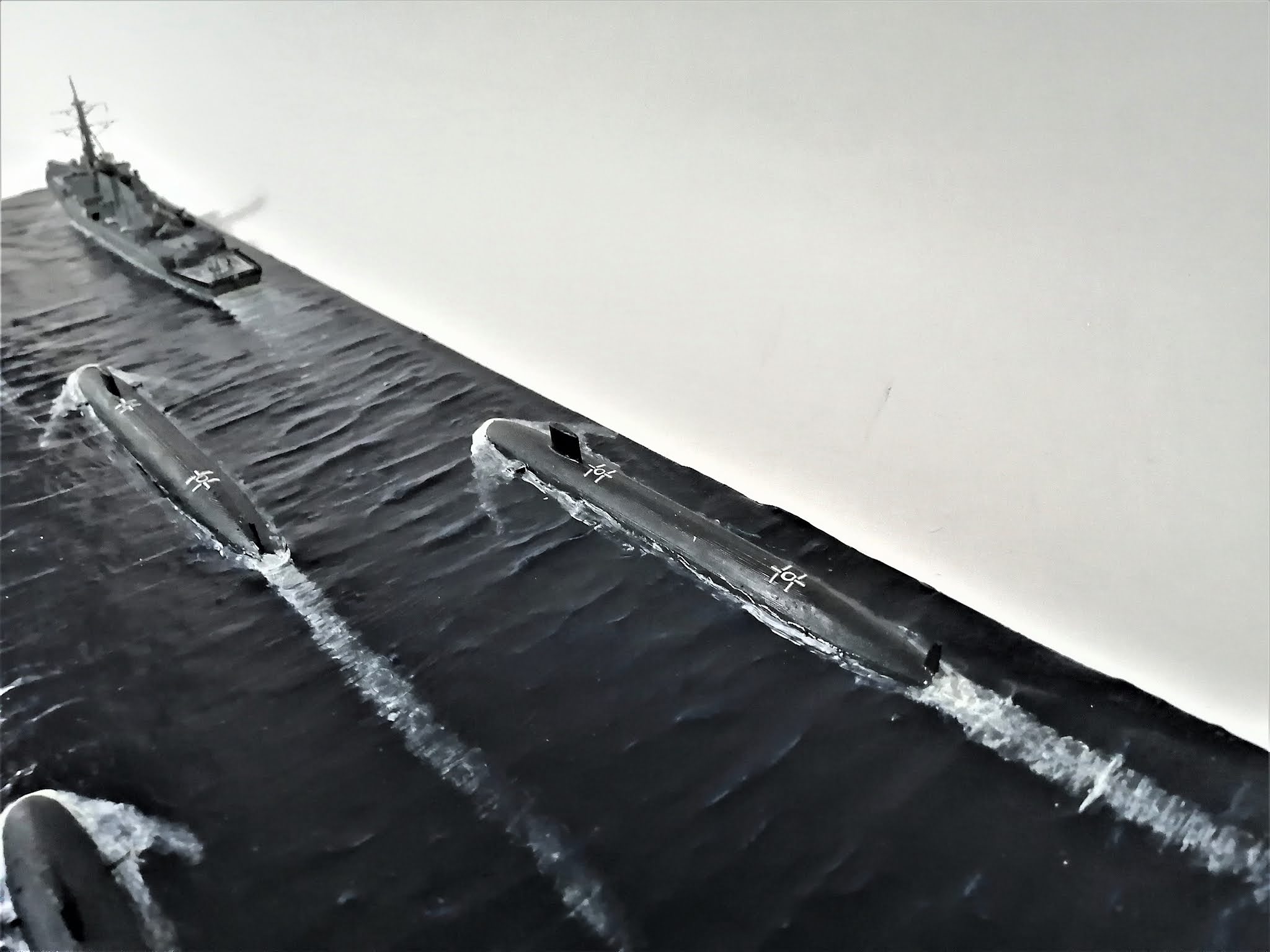
USS Vermont SSN-792

 Scale 1:700 Brand Inizio (Kit score 5/10)


www.facebook.com/ericknnavas/

www.instagram.com/ships_and_models_by_ericknavas/

USS Vermont (SSN-792) is a Virginia-class nuclear powered attack submarine in the United States Navy. She is the 19th boat of the class and the third vessel of the Navy to be named for the U.S. state of Vermont. Then Secretary of the Navy, Ray Mabus, announced her name on 18 September 2014.

Vermont was part of a $17.6 billion contract awarded by the U.S. Navy to General Dynamics Electric Boat to construct ten Virginia-class submarines, the first of the Block IV type.

On 20 October 2018, Vermont was christened with a bottle of Vermont sparkling apple wine during a ceremony held at the Electric Boat facility in Groton, Connecticut. She was delivered to the United States Navy on 17 April 2020.

In December 2020, Vermont sailed to Brazil to attend the launch of Brazilian Navy submarine Humaitá and perform an exercise with submarine Tupi.

General characteristics

Class and type: Virginia-class submarine

Displacement: 7,800 tons

Length: 377 ft (115 m)[4]

Beam: 34 ft (10.4 m)[4]

Draft: 32 ft (9.8 m)[4]

Propulsion: S9G reactor, auxiliary diesel engine

Speed: 25 knots (46 km/h)

Endurance: can remain submerged indefinitely dependent on food stores and maintenance requirements.

Test depth: greater than 800 ft (244 m)

Complement:

15 officers

120 enlisted men and women

Armament: 12 VLS tubes, four 21 inch (530 mm) torpedo tubes for Mk-48 torpedoes BGM-109 Tomahawk


USS Oregon SSN-793

  Scale 1:700 Brand Inizio (Kit score 5/10)


www.facebook.com/ericknnavas/

www.instagram.com/ships_and_models_by_ericknavas/

Oregon will be a Virginia-class submarine, commemorating the history between the U.S. state of Oregon and the United States Navy. Secretary of the Navy Ray Mabus announced its name on 10 October 2014 at a ceremony hosted at the Battleship Oregon Memorial in Portland's Tom McCall Waterfront Park.

Oregon's keel was laid down on 8 July 2017, in a ceremony held at the Quonset Point Facility of General Dynamics Electric Boat in North Kingstown, Rhode Island, with sponsor Mrs. Dana L. Richardson, wife of the Chief of Naval Operations, ADM John Richardson, in attendance. On 5 October 2019, Mrs Richardson christened Oregon at Electric Boat hall in Groton, Connecticut.

A contract modification for Oregon SSN-793, Montana SSN-794, and Hyman G. Rickover (SSN-795) was initially awarded to General Dynamics Electric Boat for $594.7 million in April 2012. On 23 December 2014 they were awarded an additional $121.8 million contract modification to buy long lead-time material for the three Virginia-class submarines. The U.S. Navy awarded General Dynamics Electric Boat the contract to construct 10 Block IV Virginia-class submarines for $17.6 billion on 28 April 2014. Vermont commenced in May 2014 with the tenth ship scheduled for delivery in 2023.[5] CDR Lacy Lodmell took over as commanding officer 20 November 2020.

General characteristics

Class and type: Virginia-class submarine

Displacement: 7,800 tons

Length: 377 ft (115 m)[5]

Beam: 34 ft (10.4 m)[5]

Draft: 32 ft (9.8 m)[5]

Propulsion: S9G reactor auxiliary diesel engine

Speed: 25 knots (46 km/h; 29 mph)

Endurance: can remain submerged for up to 3 months

Test depth: greater than 800 ft (244 m)

Complement:

15 officers

120 enlisted men

Armament:

12 x VLS tubes for BGM-109 Tomahawk

4 x 21-inch (533 mm) torpedo tubes for Mk-48 torpedoes


USS New Jersey SSN-796

 Scale 1:700 Brand Inizio (Kit score 5/10)


www.facebook.com/ericknnavas/

www.instagram.com/ships_and_models_by_ericknavas/

New Jersey (SSN-796), a Virginia-class submarine, will be the third U.S. Navy vessel named for the state of New Jersey. Secretary of the Navy Ray Mabus announced the name on May 24, 2015, at a ceremony in Jersey City, New Jersey.

New Jersey's construction reached pressure hull completion in February 2021. The construction milestone signifies that all of the submarine’s hull sections have been joined to form a single, watertight unit. The boat is currently 72% complete as of 9 March 2021.

General characteristics

Class and type: Virginia-class submarine

Displacement: 7,800 tons

Length: 377 ft (115 m)

Beam: 34 ft (10.4 m)

Draft: 32 ft (9.8 m)

Propulsion: S9G reactor auxiliary diesel engine

Speed: 25 knots (46 km/h)

Endurance: can remain submerged for up to 3 months

Test depth: greater than 800 ft (244 m)

Complement:

15 officers

120 enlisted men

Armament:

12 x VLS tubes for BGM-109 Tomahawk

4 x 21-inch (533 mm) torpedo tubes for Mk-48 torpedoes


USS Montana SSN-794

 Scale 1:700 Brand Inizio (Kit score 5/10)


www.facebook.com/ericknnavas/

www.instagram.com/ships_and_models_by_ericknavas/

Montana (SSN-794) is a Virginia-class submarine of the United States Navy. She will honor the U.S. State of Montana. Secretary of the Navy Ray Mabus announced the name on 3 September 2015 at a ceremony hosted in Billings, Montana with U.S. Senator Jon Tester. She will be only the second commissioned warship to bear the name.

A contract modification for USS Oregon (SSN-793), Montana (SSN-794), and USS Hyman G. Rickover (SSN-795) was initially awarded to General Dynamics Electric Boat for $594.7 million in April 2012. On 23 December 2014, they were awarded an additional $121.8 million contract modification to buy long lead-time material for the three Virginia-class submarines. The U.S. Navy awarded General Dynamics Electric Boat the contract to construct 10 Block IV Virginia-class submarines for $17.6 billion on 28 April 2014. The tenth boat is scheduled for delivery in 2023.

Construction of Montana began in May 2015 at Huntington Ingalls Newport News Shipbuilding in Virginia. Contract completion date was expected to be in May 2020, but this was delayed because of the COVID pandemic.

Montana's sponsor and former U.S. Interior Secretary Sally Jewell christened the vessel on 12 September 2020 at Huntington Ingalls Newport News Shipbuilding. Despite the COVID pandemic, the virtual ceremony went well. Montana was rolled out on October 15, 2020 and will be delivered to the Navy by mid-2021. She was launched in February 2021.

General characteristics

Class and type: Virginia-class submarine

Displacement: 7,800 tons

Length: 377 ft (115 m)[4]

Beam: 34 ft (10.4 m)[4]

Draft: 32 ft (9.8 m)[4]

Propulsion: S9G reactor auxiliary diesel engine

Speed: 25 knots (46 km/h)

Endurance: can remain submerged for up to 3 months

Test depth: greater than 800 ft (244 m)

Complement:

15 officers

120 enlisted men

Armament: 12 VLS tubes, four 21 inch (530 mm) torpedo tubes for Mk-48 torpedoes BGM-109 Tomahawk


USS Iowa SSN-797

 Scale 1:700 Brand Inizio (Kit score 5/10)


www.facebook.com/ericknnavas/

www.instagram.com/ships_and_models_by_ericknavas/

Iowa (SSN-797), a Virginia-class submarine, will be the fourth U.S. Navy vessel named for the state of Iowa. Secretary of the Navy Ray Mabus officially announced the name on September 2, 2015, during a news briefing at Iowa State University.

History

United States

Name: USS Iowa

Namesake: State of Iowa

Ordered: 28 April 2014[1]

Builder: General Dynamics Electric Boat, Groton, Connecticut

Laid down: 20 August 2019[2]

Status: Under construction

General characteristics

Class and type: Virginia-class submarine

Displacement: 7,800 tons

Length: 377 ft (115 m)

Beam: 34 ft (10.4 m)

Draft: 32 ft (9.8 m)

Propulsion: S9G reactor auxiliary diesel engine

Speed: 25 knots (46 km/h; 29 mph)

Endurance: can remain submerged for up to 3 months

Test depth: greater than 800 ft (244 m)

Complement:

15 officers

120 enlisted men

Armament:

12 x VLS tubes

4 x 21-inch (530 mm) torpedo tubes for Mk-48 torpedoes

BGM-109 Tomahawk


USS Hyman G. Rickover SSN-795

 Scale 1:700 Brand Inizio (Kit score 5/10)


www.facebook.com/ericknnavas/

www.instagram.com/ships_and_models_by_ericknavas/

USS Hyman G. Rickover (SSN-795), will be a Virginia-class submarine, the second submarine of the United States Navy commemorating Admiral Hyman G. Rickover, pioneer of the nuclear Navy.[4] The boat's sponsor is Darleen Greenert, wife of then Chief of Naval Operations, ADM Jonathan Greenert. Both the boat's name and her sponsor were announced by the Secretary of the Navy at a ceremony at the Washington Navy Yard on 9 January 2015.

The first USS Hyman G. Rickover (SSN-709) was a Los Angeles-class submarine, and the only submarine of its class not to be named after a United States city or town. This submarine will be the second of its class not to be named after a U.S. state; the first was the USS John Warner (SSN-785).

The USS Hyman G. Rickover (SSN-795) will be commissioned in late 2021 or early 2022 as part of a week-long celebration. The USS Hyman G. Rickover Commissioning Committee was established by the Union League Club of Chicago.

General characteristics

Class and type: Virginia-class submarine

Displacement: 7,800 tons

Length: 377 ft (115 m)[1]

Beam: 34 ft (10.4 m)[1]

Draft: 32 ft (9.8 m)[1]

Propulsion: S9G reactor auxiliary diesel engine

Speed: 25 knots (46 km/h)

Test depth: greater than 800 ft (244 m)

Complement: 134 officers and men

Armament: 12 VLS tubes, four 21 inch (530 mm) torpedo tubes for Mk-48 torpedoes BGM-109 Tomahawk


USS Delaware SSN-791

  Scale 1:700 Brand Inizio (Kit score 5/10)


www.facebook.com/ericknnavas/

www.instagram.com/ships_and_models_by_ericknavas/

USS Delaware (SSN-791) is a Virginia-class attack submarine built for the United States Navy. The contract to build her was awarded to Huntington Ingalls Industries in partnership with the Electric Boat division of General Dynamics in Newport News, Virginia on 22 December 2008. This boat is the eighth and final of the Block III submarines that feature a revised bow, including some technology from Ohio-class SSGNs. Construction on Delaware began in September 2013. She was christened on 20 October 2018. She was commissioned administratively after the standard commissioning ceremony was cancelled due to public health concerns over the COVID-19 coronavirus pandemic Delaware was the first ever US ship commissioned while underwater.

USS Delaware is 377 feet (115 m) long, 33 feet (10 m) wide, has a maximum draft of 32 feet (9.8 m) and displaces 7,800 tonnes (7,700 long tons; 8,600 short tons). She is propelled by nuclear power, has a single semi-pump jet style propulsor unit and a complement of 15 officers and 117 enlisted crew members.

General characteristics

Class and type: Virginia-class attack submarine

Displacement: 7800 tons light, 7800 tons full

Length: 114.9 m (377 ft)

Beam: 10.3 m (34 ft)

Propulsion: S9G reactor

Speed: 25 knots (46 km/h; 29 mph)[6]

Range: Essentially unlimited distance; 33 years

Test depth: greater than 800 ft (240 m)[7]

Complement: 134 officers and men